Case Study
How the LIV library provides 24/7 information services with a service terminal
The LIV library is expanding its hybrid Open Library concept with a multi-level service terminal from Mercury.ai: AI chatbot, 'Call a Librarian', and 'Book a Librarian'.

Project Data at a Glance
Institution: Bibliothek LIV – lernen. informieren. vernetzen. (Joint institution of the Heilbronn University of Applied Sciences and the Baden-Wuerttemberg Cooperative State University in cooperation with TUM Campus Heilbronn gGmbH)
Industry: University library, public sector
Physical Locations:
Bildungscampus Heilbronn
TechCampus Heilbronn (where the initial testing phase is taking place)
Künzelsau location
Schwäbisch Hall location
Channels: Service terminal (physical kiosk on site), Microsoft Teams
About the Bibliothek LIV
The Bibliothek LIV – lernen. informieren. vernetzen. is a joint non-legal entity of the Heilbronn University of Applied Sciences and the Baden-Wuerttemberg Cooperative State University in cooperation with TUM Campus Heilbronn gGmbH.
As part of its Open Library strategy, LIV aims to gradually transition three of its four locations into a hybrid Open Library concept to provide extended opening hours for its users. In doing so, the library deliberately distinguishes between library opening hours and service hours with personal support provided by library staff on site.
To support users digitally, LIV has developed a multi-level service concept to ensure that guidance and information services remain available even during unstaffed opening hours.
Mercury.ai is supporting LIV in implementing this concept. In addition to an AI-powered chatbot as the first service level, both partners are working together on a "Call a Librarian" and a "Book a Librarian" feature to provide support for more complex queries independent of location and time in the future.
Mariel Galvaire Monroy
Innovation Management Employee, Bibliothek LIV – Heilbronn University of Applied Sciences
“With the chatbot, we are creating an additional digital channel to access our services. Particularly as part of our Open Library concept, we see great potential in answering frequently asked questions regardless of service hours.”
Initial Situation: Expanding Access Without Compromising Service Quality
LIV's goal is to introduce hybrid Open Library concepts at three of its locations in order to significantly extend access to learning, study, and information services beyond traditional service hours. By doing so, the library wishes to address the desire of many users for maximum flexibility when using the libraries.
At the same time, experience showed that relying solely on existing staff resources made it difficult to guarantee reliably extended service hours at these locations in the long term. Smaller teams in particular must compensate for absences due to vacation, illness, or other leaves, meaning opening hours regularly depend on the actual staffing situation.
Against this background, the challenge arose of expanding library access without compromising service quality. For LIV, it was clear from the outset that a hybrid Open Library concept can only succeed if users can also receive support and orientation during unstaffed opening hours.
LIV's vision is therefore to subtly complement personal library services with digital support offerings. These are not intended to replace staff, but rather to expand the service, answer frequent questions in a low-barrier manner, and facilitate access to library assistance regardless of time and place.
The Solution with Mercury.ai: The Service Terminal as a Central Hub
To implement the concept of a multi-level digital service expansion, a tender was issued for the development of a suitable solution. Within the framework of the procurement process, Mercury.ai was awarded the contract. Since then, the partners have been working together to implement the so-called service terminal, designed to bundle various user information and consultation needs at a single, central hub.
Level 1: AI-Powered Chatbot
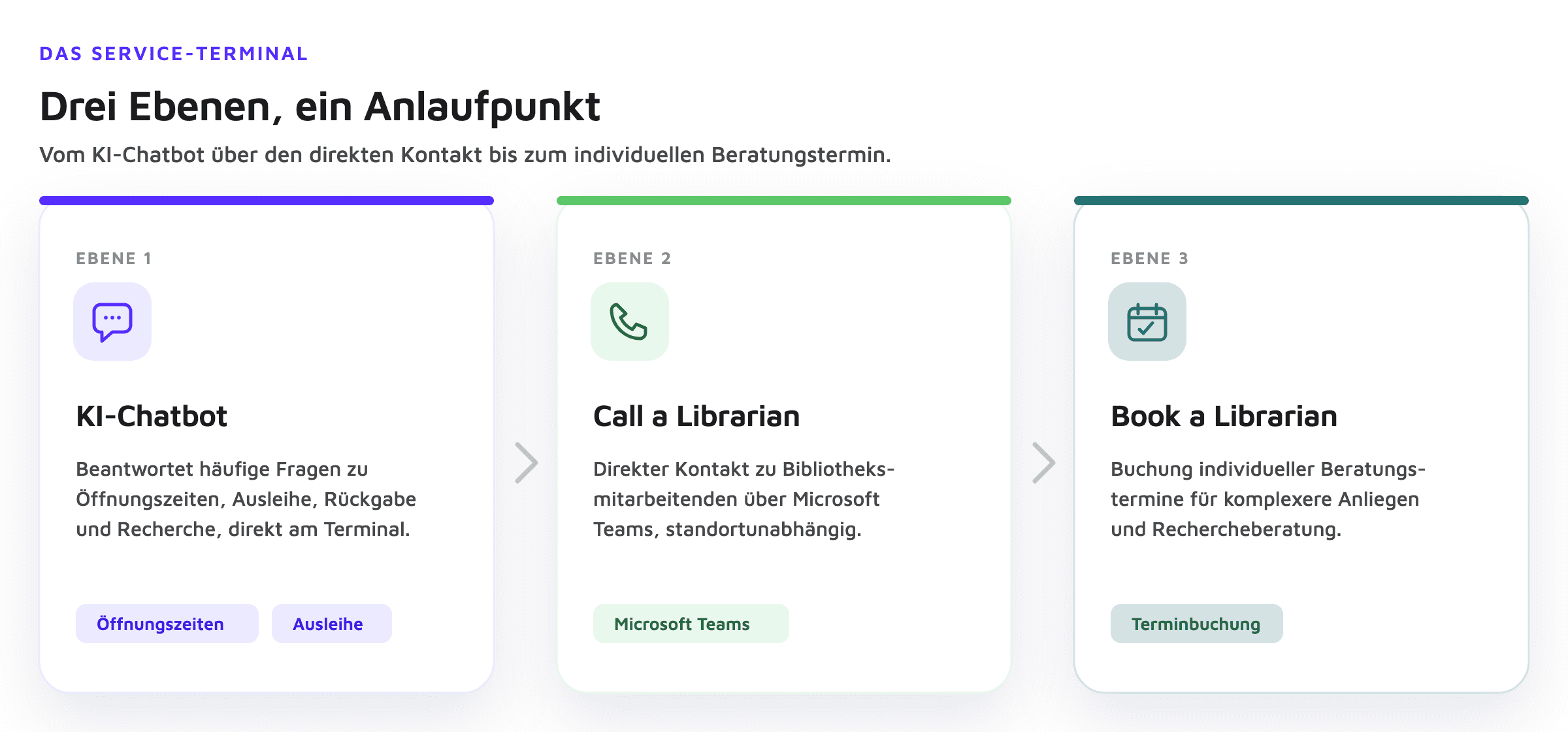
The first level is an AI-powered chatbot provided via the service terminal inside the library. The solution is currently in its beta testing phase at the TechCampus Heilbronn. In addition to technical tests in live operation, the underlying catalog of questions and knowledge is continuously being expanded and optimized based on initial findings. The live launch of the system is scheduled for calendar week 41 in 2026. The objective of this first service level is to provide assistance with frequently asked questions, such as those regarding opening hours, borrowing and returning books, search options, or location-specific services.
Level 2: “Call a Librarian”
The second level of the concept is the “Call a Librarian” function. This is designed to allow users to establish a connection via Microsoft Teams directly from the kiosk or service terminal to get in touch with library staff. This enables staff to provide personal support and answer questions that go beyond the capabilities of the chatbot, regardless of location.
Level 3: “Book a Librarian”
The third level is the “Book a Librarian” function. This feature will allow users to book individual consultation appointments, particularly when direct support via the second level is not fully feasible—either due to the complexity of the inquiry or a lack of immediate time capacity. This is intended to provide targeted guidance for more complex issues, such as personalized research consulting or assistance with academic writing.
By combining these three levels, LIV expects to expand its existing service portfolio with a tiered digital support offering. The vision is to provide users with the most comprehensive guidance possible—ranging from answering common standard questions to direct contact with library staff, and finally to individual consultation appointments. In this way, a seamless advisory service is to be established in the long run, capable of addressing different information and support needs regardless of location and time, while sustainably supporting the requirements of the hybrid Open Library concept.
Implementation: Step-by-Step Development with Dedicated Contact Persons
The project was intentionally designed as a step-by-step development of a new service offering. Following the completion of the procurement process, the requirements were specified together, and implementation was supported through regular alignment meetings. In doing so, LIV benefits from dedicated technical and organizational contact persons at Mercury.ai who continuously accompany the project's development.
The collaboration is characterized by open and constructive communication. It takes into account both the specific requirements of a university library and the organizational frameworks of the public sector. Particularly complex coordination processes involving various stakeholders are guided by Mercury.ai in an understandable manner, enabling realistic and collaborative project management.
Furthermore, the platform allows LIV to introduce its own ideas and requirements early on and develop them further in partnership. This ensures that new insights gained during the project can be flexibly integrated into the further development of the service terminal. Currently, the project is in the testing and optimization phase to transition the first service level into live operation as scheduled.
Impact and Benefits
Since the service terminal is currently still in the testing and optimization phase, robust usage statistics or long-term empirical data are not yet available. However, based on initial tests and the underlying concept, LIV anticipates tangible added value for both users and staff.
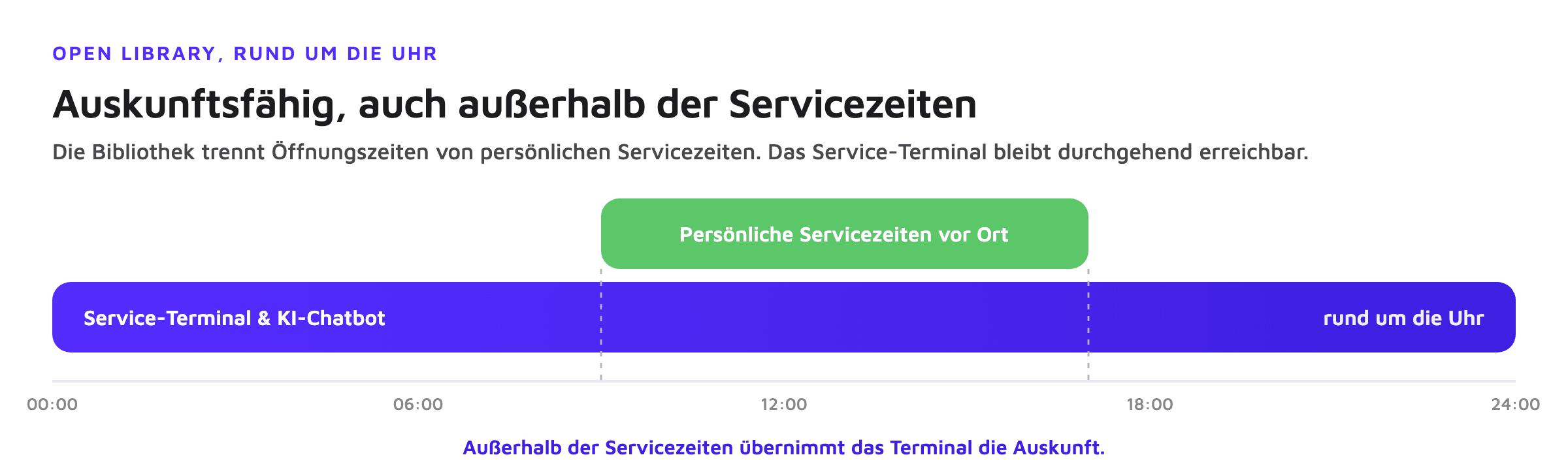
For users, the primary goal is to improve low-barrier access to information. In the future, frequently asked questions should be answered regardless of service hours. At the same time, the multi-level structure of the service terminal is designed to ensure appropriate access to library assistance, even for more complex inquiries.
In addition, the combination of the chatbot, “Call a Librarian,” and “Book a Librarian” is expected to expand access to consulting and information services, thereby sensibly supplementing existing on-site personal support. The goal is to offer users a suitable form of support, regardless of the location, time, and complexity of their inquiry.
Overall, it is expected that the service terminal will become a valuable addition to the existing service portfolio and sustainably support the further development of hybrid Open Library concepts.

Daniel Hofmann
Deputy Library Director of LIV
“As part of our Open Library strategy, we aim to make our advisory and information services available independent of location and time, in addition to regular on-site service hours. We particularly appreciate that technical questions and solution approaches are presented in a way that is easily understandable for us as a library department. This allows us to actively contribute our requirements and develop practical solutions together.”
Outlook: Next Steps
Following the planned live launch of the first service level in calendar week 41 of 2026, the initial focus will be on evaluating the insights gained and continuously developing the service terminal. In particular, the chatbot's content will be further expanded and tailored to user needs.
In parallel, the gradual implementation of the “Call a Librarian” and “Book a Librarian” service levels is planned in order to fully represent the envisioned consultation offering. Furthermore, the feasibility of transferring the concept to other LIV locations and adapting it to site-specific requirements will be evaluated.
In the long term, LIV regards the service terminal as an important building block of its hybrid Open Library concepts and intends to continue developing digitally supported advisory services in line with user requirements.
Additional reference projects
Learn more about our satisfied customers