


In many municipalities, digitalization currently means: more online forms, but barely any relief in day-to-day business. With the amendment of the Online Access Act (OZG) and the requirements of the Single Digital Gateway Regulation (SDG), the focus is shifting to the scalability of services. It is no longer enough to merely provide applications as static online forms; the expectation points toward dialogue-based interactions without major barriers.
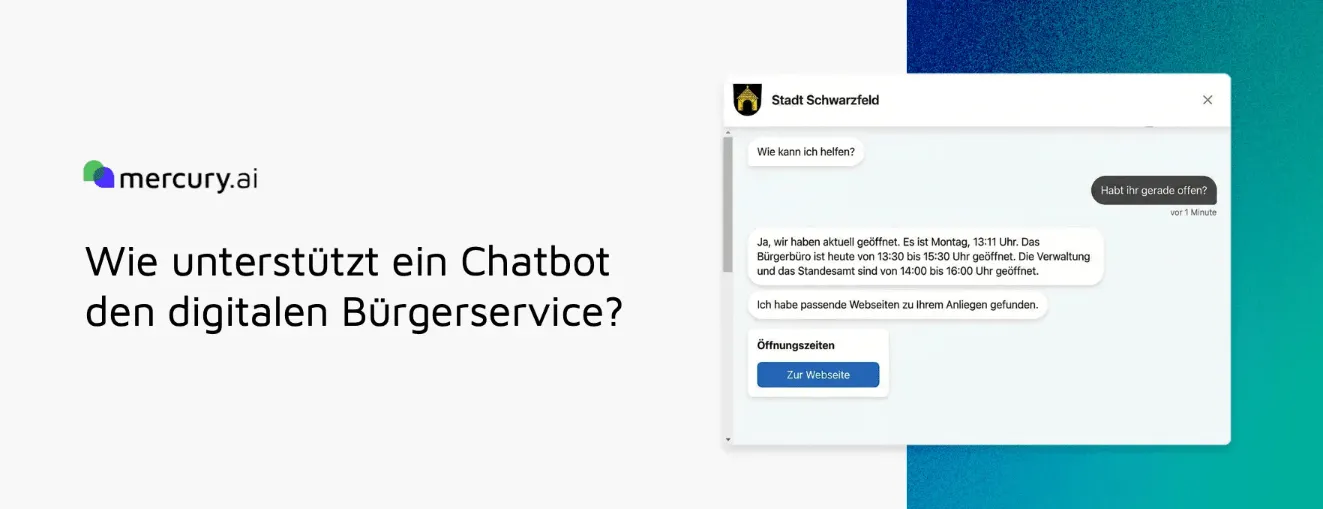
In many municipalities, the chatbot is evolving from a pure information channel into an integral element of digital citizen services. It combines information, pre-screening, and structured routing of requests. The decisive factors for success are not the linguistic capabilities of generic AI models, but process reliability and data sovereignty.
Reduction of bureaucracy presents municipalities with new digital requirements
Additionally, with the Fourth Bureaucracy Relief Act (BEG IV), which has largely been in force since January 1, 2025, the reduction of bureaucracy is becoming very concrete for the first time – also for cities and municipalities. The elimination of written form requirements, the greater use of text form, and reduced documentation and proof obligations are noticeably changing expectations of municipal administrative processes. For administrations, this means: information must be made digitally understandable, legally secure, and accessible with low barriers. The challenge lies less in the legal situation itself than in the practical implementation on site – especially where citizens expect orientation, explanation, and reliability. Digital chat solutions are thus increasingly moving into focus as a structural element of modern administrative work. This is where modern chatbot solutions come in as structural assistance in the initial contact with citizens.
From information to process support: The evolution of citizen dialogue
Previous chatbot solutions in municipalities often served as purely informative guideposts. They answered questions about responsibilities or linked to PDF documents. These guidepost chatbots (or simple FAQ chatbots) save time on the website, but not in the specialist departments. Citizens are sent from subpage to subpage without their request actually being processed. The current OZG development demands deeper integration to enable media-consistent processes.
Supporting OZG maturity levels: From information to transaction
A chatbot that is systematically integrated into administrative processes helps to achieve higher maturity levels in the OZG. The focus here is on the efficient preparation of processes - not their final evaluation:
The bot delivers precise answers based on your administrative data instead of leaving citizens alone with confusing lists of links (information is only provided).
Inquiries are pre-qualified and data is validated so that they can be seamlessly transferred to internal specialist departments (e.g., in registration offices or business registrations) (transactions/applications are prepared).
This is about sensible support instead of substitution: freeing staff from repetitive standard inquiries serves to secure capacities for personal and complex individual case advice. Legal reviews, discretionary decisions, and special cases remain with humans or caseworkers through editorial dialogues.
Control instead of coincidence: Why AI in citizen services must be restricted (RAG and hybrid architectures)
Generic AI systems that are based solely on public web knowledge are unsuitable for official information. The danger of "hallucinations" – i.e., factually incorrect but plausible-sounding answers – is unacceptable for legally binding information.
Controlled knowledge base instead of free text generation with Mercury Intelligence
Instead of using uncontrolled web scraping, Mercury.ai utilizes, among other methods, an orchestrated process (Retrieval Augmented Generation - RAG):
|
|
|
Only explicitly approved documents, statutes, and FAQ lists serve as sources. Simply put: The chatbot is only allowed to say what has been previously approved. Nothing else. | Every response from the AI chatbot is internally traced back to the underlying document version. This supports the traceability of administrative actions. | Where processes are legally strictly defined (e.g., application paths), deterministic dialogue guidance takes effect. Generative AI handles the language understanding, but the process logic is still not left to chance: firmly defined and traceable. |
Infrastructure integration: XZuFi and the reality of the federal structure
Crucial for use in municipalities is the support of German administrative standards such as XZuFi and FIM. The chatbots and the conversational AI platform from Mercury.ai are designed to map these standards. Many solutions are not designed for these specific administrative standards because they have little experience with municipalities, cities, and communities.
Synchronization with editorial systems
A chatbot in public administration must be integrated into the existing data landscape:
Interface connection: Mercury.ai enables the adoption of service descriptions from the Content Management System (CMS). As soon as changes are approved in the editorial systems of the federal states or municipalities, they can be integrated into the chatbot's knowledge base in defined cycles.
Regional logic: By using the Official Municipality Key (AGS) and stored responsibility logics, the chatbot can direct citizens specifically to the locally responsible offices – also taking into account district structures or purpose associations.
Accessibility and inclusion: BITV 2.0 as a foundation
Public software must be accessible to all citizens. Compliance with BITV 2.0 (based on EN 301 549) is therefore not an optional feature, but a core criterion.
Barriers-free design and assistance functions
The chatbot widget is optimized for screen readers, fully keyboard-operable, and meets contrast requirements according to WCAG 2.1.
The chatbot enables communication in numerous languages, which facilitates access to information for many citizens.
Mercury.ai offers assistance functions to transform complex texts into drafts of Plain Language (Leichte Sprache). Important: Since Leichte Sprache is standardized (e.g., DIN SPEC 33429), these AI drafts serve as a valuable working basis for mandatory human review and quality assurance.
Data sovereignty and legal certainty
In addition to GDPR compliance, avoiding a one-sided technological lock-in is critical for German authorities. Mercury.ai consistently follows, among others, the strategy of the IT Planning Council for strengthening digital sovereignty: the goal is to reduce dependency on individual IT service providers to ensure the long-term operational capability of the administration.
Security "Made in Europe"
|
Distinction from international models
While international AI models like those from OpenAI (ChatGPT) are linguistically impressive, they are not designed for the specific requirements of German administrations. For global language models, specific German administrative standards are simply irrelevant. They are not trained on German administrative standards such as XZuFi, FIM, or OZG process logic and cannot natively map their structural requirements.
The decisive difference: while generic AI only generates texts based on probabilities, Mercury.ai ensures legally secure and standard-compliant delivery of information that corresponds one-to-one with municipal processes.
Conclusion: Digital transformation with a sense of proportion
A chatbot for your administration is a tool to strengthen the operational capability of offices in times of skills shortages. However, it is not a "plug-and-play" product; rather, it requires clean integration into administrative processes and data standards. Mercury.ai is your partner to unite innovation with the necessary administrative discipline: sovereign in hosting, controlled in AI generation, and inclusive in design.
Next step: Together, we will identify the processes in your administration with the highest automation potential. Schedule a non-binding consultation.