


An AI telephone assistant answers calls, understands the request in spoken language, and resolves standard cases independently. GDPR compliance is ensured through processing in Germany, a data processing agreement (DPA), and binding the answers to verified sources. Voice data, which constitutes personal data, is generated during a phone call, making the handling of this data decisive for compliance. This article shows where data privacy becomes critical and which criteria make an AI telephone assistant legally secure.
At a glance
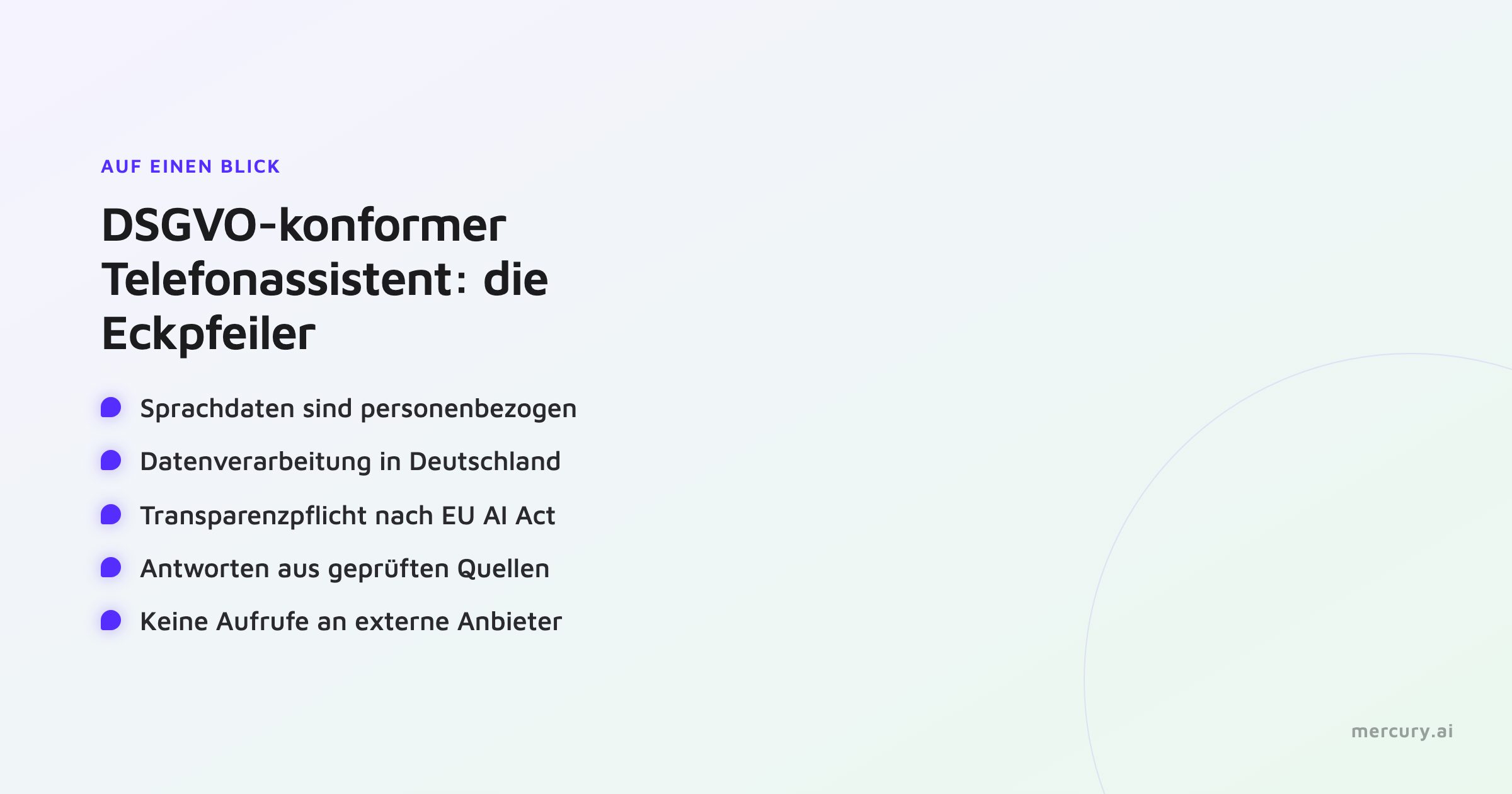
Voice data is personal data: A call contains names, requests, and the voice itself, which triggers the GDPR.
Data processing in Germany, without transfer to third countries, secured via a data processing agreement.
Transparency obligation under the EU AI Act: Callers must recognize that an AI system is speaking.
Answers from verified sources, instead of being freely generated by the language model.
PCI-DSS for payment data, in case payments are made over the phone.
No API calls to external providers for the generative component.
What an AI telephone assistant does
An AI telephone assistant is a voicebot that handles incoming calls in customer service. Callers describe their requests freely, the system recognizes the intent, and responds in spoken language. The assistant resolves standard cases like booking appointments, checking status, or changing addresses independently, and hands over complex inquiries to employees. The basics and use cases are explored in depth in the article on the voicebot for customer service.
Where data privacy becomes critical on the phone
A phone call contains more personal data than a chat. In addition to names and requests, the voice itself is captured. Many AI telephone assistants route speech recognition through speech APIs processed outside the EU. This means the recording leaves the controlled environment, and the data controller loses control over data location and deletion.
For GDPR compliance, where the processing takes place is therefore the primary factor. Processing in Germany without transfer to third countries keeps the data within a controlled framework. It is also important whether the generative component sends calls to external providers. A system without such calls keeps the conversation content within its own operations.
Criteria for a GDPR-compliant telephone assistant
Data location and data processing. Processing in the EU, documented via a data processing agreement. Ask about the hosting location and the subprocessors used.
Transparency obligation. The EU AI Act requires callers to recognize that they are speaking with an AI system. A clear announcement at the start of the call fulfills this obligation.
Source binding. There is no visible source on the phone. An incorrect response therefore carries a lot of weight. A system that binds its answers to verified knowledge prevents fabricated statements.
Payment data. If payments are processed over the phone, PCI-DSS is relevant. The assistant should comply with this standard.

How Mercury.ai secures the telephone assistant
Mercury Voice hosts the AI telephone assistant on an architecture that processes in Germany. A model orchestration of specialized models recognizes the request, checks the appropriate source, and formulates the response only at the very end. The language model verbalizes; it does not decide on facts. This keeps the information bound to the company's verified knowledge.
The models are licensed, self-hosted Mistral models. No calls are sent to external providers, and the data remains in Germany. The assistant connects to existing telephone systems like Avaya or Genesys via SIP trunk and maintains the PCI-DSS standard for payments. How binding to verified sources works technically is shown in the article on GDPR- and EU-AI-Act-compliant AI chatbots.
Frequently Asked Questions
Is an AI telephone assistant GDPR-compliant?
An AI telephone assistant processes personal voice data and is subject to the GDPR. Compliance is achieved through processing in the EU, a data processing agreement, and binding the answers to verified sources. With Mercury.ai, the data is stored in Germany.
Do I have to inform callers that an AI is speaking?
Yes. The EU AI Act requires that it must be recognizable that an AI system is speaking. An announcement at the beginning of the call fulfills this transparency obligation.
Where is the data privacy risk with AI telephone assistants?
Mainly in speech recognition. If it is processed via speech APIs outside the EU, the recording leaves the controlled environment. Processing in Germany avoids this.
Can an AI telephone assistant accept payments?
Yes, provided it complies with the PCI-DSS standard. Mercury Voice supports payment processes according to PCI-DSS.
Conclusion
An AI telephone assistant automates the voice channel and remains GDPR-compliant if the data location, transparency obligation, and source binding are correct. The critical point is speech recognition: it belongs within a controlled framework. Mercury Voice processes in Germany, binds answers to verified knowledge, and sends no calls to external providers.
Would you like to automate your telephone channel in a GDPR-compliant manner? Talk to us or take a look at Mercury Voice.