

An HR chatbot answers recurring questions from the workforce about leave, benefits, certificates, or onboarding, thereby reducing the workload of the HR department. The answers are sourced from the company's verified sources, not from a freely generating language model. For operations, both aspects matter: a tangible reduction in workload for the HR team and handling employee data in compliance with data privacy and co-determination. This guide highlights the use cases, data privacy aspects, and criteria for choosing a provider.
At a Glance
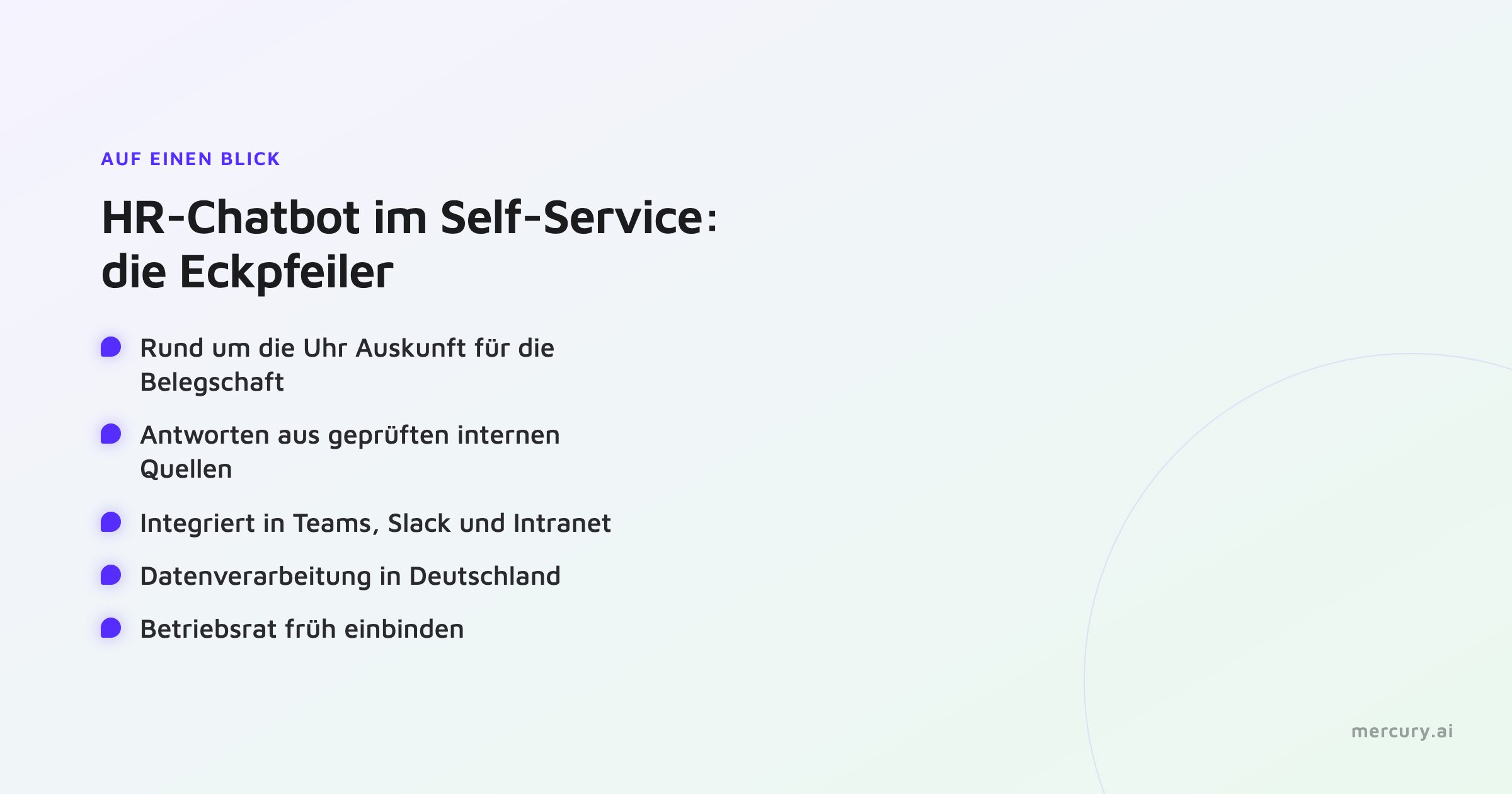
24/7 Information: Questions about leave, payroll, benefits, or certificates are automated, even outside of HR office hours.
Answers from verified sources, bound to company agreements and internal guidelines instead of the knowledge of a public AI tool.
Integrated into Microsoft Teams, Slack, and the intranet, right where the workforce already works.
Data processing in Germany, with a data processing agreement and involvement of the works council.
Structured handover to the HR team as soon as a case requires a personal decision.
Measurable workload reduction: up to 30 to 60 minutes of saved search time per employee per day.
Why HR Departments Rely on Conversational AI
A large part of HR work consists of recurring questions. How many vacation days do I have left, where can I find my certificate, what benefits am I entitled to, how does the JobRad work. These questions reach the HR team via email, phone, and hallway conversations, consuming time that is then lacking for topics with a personal context.
An HR chatbot handles this first level. The workforce receives information immediately, and the HR team gains time for matters that require experience and judgment. The saved search time adds up, in practice, to as much as 30 to 60 minutes per employee per day.
The Problem with Public AI Tools
Without an internal channel, employees resort to public AI tools and ask them about regulations regarding leave, parental leave, or payroll. The answer sounds plausible, but it does not match the specific company agreement. This results in misinformation that must later be corrected by the HR team.
An HR chatbot solves this by binding the answers to the company's verified sources. The workforce receives binding information from internal policies, not a general assumption from the internet. How this source binding works technically is shown in the article on hallucinations in AI chatbots.
Use Cases in HR Self-Service
An HR chatbot is suitable for matters that occur frequently and are clearly regulated:
Leave and Absence: Query remaining vacation days, explain application paths, state deadlines.
Certificates and Documents: Provide payslips, employment certificates, or proofs.
Benefits: Answer questions about JobRad, subsidies, pension schemes, or training.
Onboarding: Guide new employees through their first weeks with checklists and contact persons.
Recruiting Relief: Pre-screen incoming applications and answer standard questions from candidates.
For matters requiring personal judgment, such as a conflict or an individual agreement, the bot hands over to the HR team.
Data Privacy and Co-Determination
HR data is among the most sensitive data in a company. Therefore, three aspects are particularly crucial when introducing an HR chatbot.
Data Location. The chatbot processes personal data of the workforce. For GDPR compliance, where this data resides is decisive. Processing in Germany without transmission to third countries is the robust path, secured via a data processing agreement.
Co-Determination. The use of an HR chatbot touches upon the co-determination rights of the works council. A works agreement regulates the purpose, data scope, and evaluation. Involve the works council early to speed up the rollout.
Source Binding. Answers to labor law questions must be correct. A system that binds its information to verified internal documents prevents incorrect information that could have legal consequences.
How Mercury.ai Solves HR Self-Service
Mercury.ai brings Conversational AI to the HR channel and follows a source-bound architecture. An orchestration of specialized models recognizes the question, checks the appropriate internal source, and only formulates the answer at the very end. The language model verbalizes; it does not decide on facts. This keeps the information bound to company agreements and guidelines.
The models are licensed, self-hosted Mistral models. No API calls are made to external providers; the data remains in Germany. The HR chatbot integrates into Microsoft Teams, Slack, and the intranet, right where the workforce already works. A detailed overview is available on the HR Chatbot page.
Frequently Asked Questions
What is an HR chatbot?
An HR chatbot is an assistant that answers recurring questions from the workforce regarding HR topics, such as leave, benefits, or certificates. The answers are sourced from the company's verified sources.
Is an HR chatbot GDPR-compliant?
An HR chatbot processes personal employee data and is subject to GDPR. Operation is compliant through processing in the EU, a data processing agreement, and a works agreement. At Mercury.ai, the data is located in Germany.
Does the works council need to be involved?
Yes. The deployment of an HR chatbot touches upon co-determination. A works agreement regulates the purpose, data scope, and evaluation. Early involvement of the works council speeds up the rollout.
Which systems can an HR chatbot be integrated into?
Into the channels used in daily work life, such as Microsoft Teams, Slack, and the intranet.
Which questions does an HR chatbot not answer itself?
Matters with a personal context or requiring an individual decision, such as conflicts or special agreements. The bot hands these over to the HR team.
Conclusion
An HR chatbot relieves the HR department of recurring questions and provides the workforce with binding information from internal policies 24/7. Crucial factors are binding the answers to verified sources, a data location in Germany, and the early involvement of the works council. Mercury.ai brings these aspects together, following the same architecture as in customer service.
Would you like to reduce your HR team's workload? Get in touch with us or take a look at the HR Chatbot.