


Today, B2B customers prefer to do their own research before calling sales. According to a Gartner study, 67% of B2B buyers prefer a purchase without rep contact, and 70% want a completely digital self-service. For simple products, this works well. For a portfolio with hundreds of variants, self-research reaches its limit: the customer finds too many similar items and does not know which one fits their system.
This is where the difference between a public chatbot and an assistant in the login area becomes clear. One answers general questions. The other knows the logged-in customer and advises them on their specific situation.
Why generic answers are not enough in B2B
Complex products often differ by a single attribute: voltage, connection, diameter, software version. To the customer, the series looks identical, but for the selection, exactly that one deviation matters. An assistant that only knows the public catalog cannot resolve this question and answers in general terms. If the customer then selects the wrong variant, returns or downtime follow.
In addition, there is the so-called translation gap: the customer describes their request in everyday language, while the knowledge is stored in technical language. "The small valve on the 200" must be translated into the matching part number. This mapping only succeeds with the right context, which is provided by the login area. How this translation works in detail is shown in the article on the digital product advisor.
The login area makes consulting personal
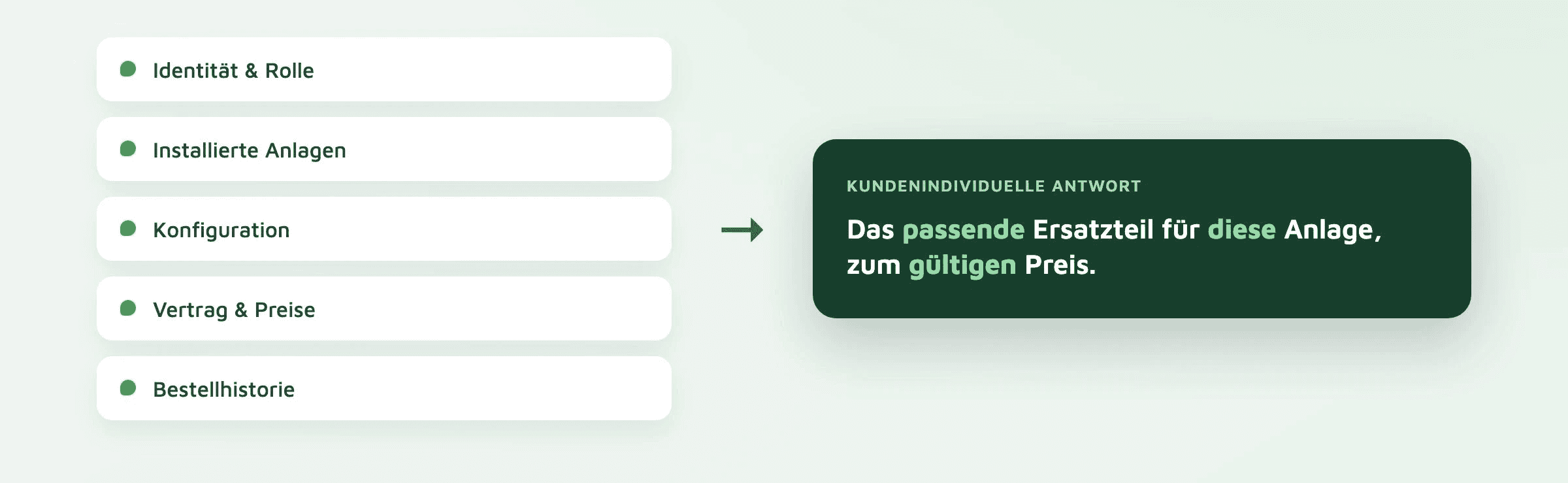
As soon as the customer is logged in, the assistant knows who they are talking to. It knows the installed products, their configuration, the stored conditions, and the order history. A general inquiry thus becomes a concrete one: the compatible spare part for exactly this system, the valid price for this customer, the realistic delivery time.
This personalization transforms the consultation. The assistant guides the customer to the matching item with targeted follow-up questions, along the attributes that actually narrow down the selection, and filters out what is out of the question for their system. Guided Selling in the login area combines the dialogue capability of the language model with what the company already knows about the customer.
Consistency instead of contradiction
A second advantage carries significant weight in B2B. The same Gartner study shows that 69% of buyers experience contradictions between information on the website and information provided by sales. Such contradictions cost trust.
An assistant whose answers are bound to verified sources and real customer data provides the same, correct information everywhere. The answer in the portal matches the data sheet and what sales says, because they all draw from the same source. If the assistant does not find a reliable data point, it hands over to a human instead of guessing. A huge loss of trust would occur if a bot recommended a spare part that cannot even be bought in the B2B-Shop.
Roles and data separation in the portal
A login area comes with responsibility, because the assistant works with sensitive data. Upon login, the portal passes the user's role to the assistant, ensuring that each user group only receives the content authorized for them. A buyer sees different conditions than a service technician, and the data of different customers remains strictly separated.
For data protection, where the processing takes place also matters. Processing in Germany, backed by a data processing agreement, is the reliable path in B2B. What role-based knowledge provisioning looks like is described in the article From Documents to AI.
What consulting in a service portal needs
For an assistant in the login area to provide reliable advice, three things must come together.
The product data is structured, with attributes, variants, and compatibility rules as data relations. The connection to the legacy systems is established so that the assistant can access customer-specific data from ERP and CRM, such as availability, price, and installed base. How this connection succeeds technically is shown in the article on CRM and ERP integration. And the handover to a human is defined, because according to Gartner, many buyers still seek confirmation from a human expert for the final complex decision.
How Mercury.ai implements this
Mercury.ai brings Guided Selling to the login area by combining these three components. The Knowledge Hub holds the structured product knowledge and binds every answer to a verifiable source. Through the integration, the assistant accesses transaction data from ERP and CRM, making the information customer-specific. The portal passes the user's role, and the assistant respects the separation of data. An orchestra of specialized models verifies the source before phrasing, significantly reducing the risk of hallucinated answers.
The Böllhoff case shows how viable this is in industrial B2B. With Mercury.ai, the specialist for fastening technology has resolved a complex portfolio and the usual media disruptions in service, resulting in qualified leads from the dialogue every day. An entry point is offered by the solution for product search and consultation.
Frequently Asked Questions
What is Guided Selling in the customer portal?
Guided Selling in the customer portal is a guided product consultation that knows the logged-in customer. The assistant uses identity, installed products, and conditions to guide the customer individually to the matching item.
Why is a chatbot in the login area better for complex products?
Because it knows the customer's context. It resolves the confusion of similar variants by accessing the specific system, configuration, and compatibility of the logged-in customer, instead of answering in general terms.
How is customer data protected in the portal?
The portal passes the user's role, each group only receives authorized content, and the data of different customers remains separated. At Mercury.ai, data is processed in Germany.
Does the assistant replace sales?
No. The assistant handles recurring consultations and pre-qualification. For the final complex decision, it hands over to a human, whom many B2B buyers still seek for confirmation.
What data does the assistant need for the consultation?
Structured product data with variants and compatibility rules, as well as access to customer-specific data from ERP and CRM such as availability, price, and installed base.
Consulting begins with context
For simple products, a public chatbot is sufficient. For a broad portfolio requiring explanation, the context determines the value. The login area provides this context, and a general information provider becomes a consultant who knows the customer and their system.
Those who structure product data, connect systems, and strictly separate roles give their B2B customers the digital self-service they expect while maintaining the reliability of their own catalog.
Would you like to bring product consulting to your customer portal? Talk to us or take a look at the solution for product search and consultation.
About the author: Dr. Hendrik ter Horst is Chief Product Officer at Mercury.ai. He holds a PhD in Computer Science from the CITEC Institute at Bielefeld University, focusing on machine information extraction and data processing. For ten years, he has been working on dialogue-based AI systems and is responsible for the conception, implementation, and validation of AI-supported applications from the initial idea to productive use.
Sources
Gartner (2025/2026): B2B Buyer Survey. 67% of B2B buyers prefer a purchase without rep contact, 70% a completely digital self-service.
Gartner (2025): B2B Buyer Survey. 69% of buyers report contradictions between information on the website and information provided by sales.