


The Sunday Evening Moment: When an FAQ Chatbot Becomes a Dead End
Imagine: A customer urgently wants to change the contract details for an account on Sunday evening or has an important follow-up question about a product. They open your company's chatbot. Thanks to modern language models (LLM), the chatbot understands the request immediately. It responds politely and empathetically, but then only sends the user a link to the login area of the customer portal.
This is precisely where the customer experience suffers, as the request remains open and the chat ends without a helpful resolution for the customer.
Let's stop talking about chatbots as mere information providers. Customers in e-commerce or banking are not looking for explanations when they ask about their parcel status or credit limit. In a service context, providing information is not enough. The decisive factor is completing the transaction.
A system that formulates fluidly but ends the conversation with the sentence "Please log in to our portal for this" does not generate economic value. It merely postpones the media disruption by a minute. To significantly reduce support costs, the strategy must shift from pure information reproduction to an end-to-end process. We are no longer talking about simple chatbots here, but about hybrid chatbots that perform real tasks and support processes through systems integration.
The Paradox: Why Generative AI Alone Does Not Solve Service Processes
We are currently witnessing the end of rigid rule-based bots. LLMs enable dialogues that feel natural and human. However, this is also where the danger lies: The model understands language but has no access to systems, data, or actions.
A purely informative system inevitably leads to three problems:
Information Ping-Pong | Forced Media Disruptions | Lack of Data Depth |
The chatbot explains instructions instead of fixing the problem directly. Customers are basically just being read an FAQ file. | Users have to leave the chat to fill out forms or log into portals. This causes the abandonment rate to skyrocket. | Without deep integration into the backend, every answer remains generic. Today, customers expect personalized messages that take their specific status (e.g. Gold status or open invoices) into account. |
Generative AI is great at understanding language. But it is not an operating system. Real automation in service requires technical guardrails and direct access to your company data—meaning access controls, APIs, and state logic.
What Is a Hybrid Chatbot? The Road to Actionability
We are talking about the automation of business transactions here. The chatbot no longer functions just as an interface for questions. It acts as a hybrid chatbot that combines generative intelligence with fixed business logic and executes tasks independently.
The true success of a Conversational AI platform is measured by the rate of completed tasks and executed end-to-end processes, not just by the "look & feel" of the messages. A hybrid chatbot takes responsibility for the entire flow:
Recognize: It identifies the intent (e.g., "I want to cancel my contract").
Validate: It securely authenticates the customer via existing interfaces (e.g., CRM synchronization).
Modify: It performs the change (e.g., master data modification, return label creation, or appointment booking) directly in your systems such as SAP, Salesforce, or Microsoft Dynamics.
Complete: The user receives confirmation instantly in the chat. The request is resolved.
The result: Many standard cases can be completed fully automatically, without manual post-processing.
Mercury Chatbot as an Intelligent Assistant in Your Service Landscape
Instead of just retrieving text modules, the chatbot actively uses data from your systems and thus automates your processes.
💡 Strategy Tip: Do not start with the most complex process. Automating simple but high-frequency tasks often yields the fastest ROI. Examples include sending return status updates or changing master data. This immediately relieves your team's workload. |
The Mercury platform approach is based on two building blocks for more control and transparency:
1. Mercury Intelligence: Knowledge Instead of Coincidence
Especially in regulated industries such as banking or insurance, "hallucinations" are absolutely unacceptable—as the Air Canada case (Heise.de) showed. Mercury Intelligence prevents access to uncontrolled world knowledge. Answers are generated exclusively based on your verified knowledge sources. A hybrid chatbot promising incorrect discounts because it gets "creative" is technically impossible.
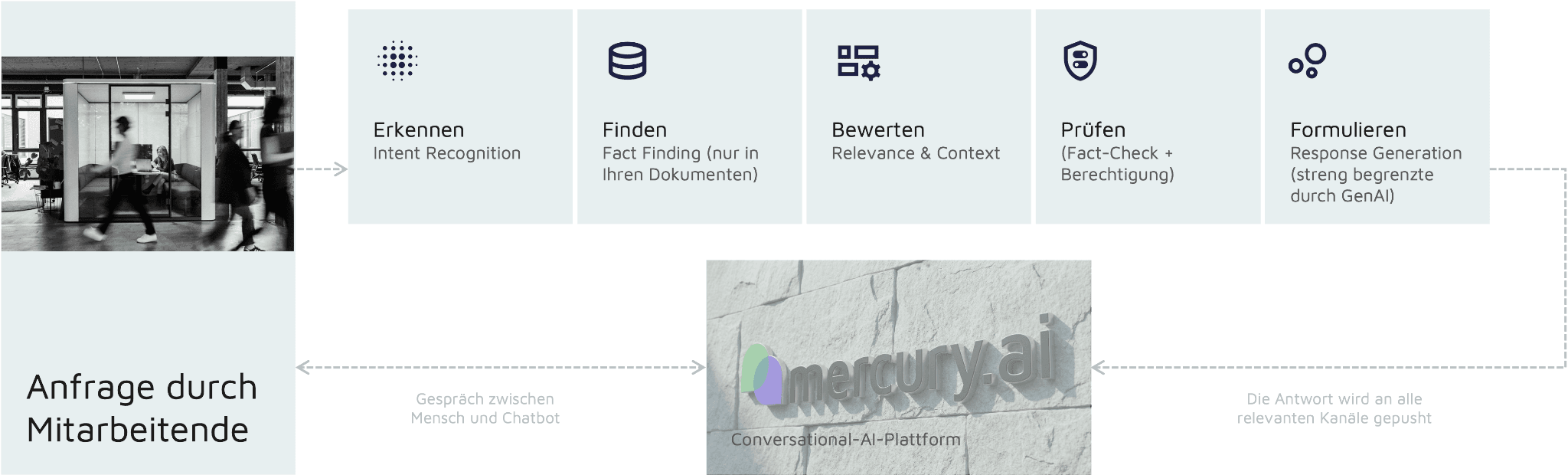
Mercury Intelligence is the technological heart of the platform, acting as an intelligent orchestration layer that combines generative AI with complete control. Instead of relying on unpredictable "world knowledge" or unstable third-party models, Mercury Intelligence generates answers exclusively based on your audited corporate data and documents. Through this hybrid approach—combining the flexibility of LLMs with deterministic guardrails—AI hallucinations are eliminated, and every answer remains traceable back to its source. This allows business departments to maintain full control over the service architecture via No-Code, while customers receive precise, brand-consistent, and regulatory-compliant solutions in real time.
2. Deep Chatbot Integration into the Ecosystem
A hybrid chatbot is only as good as its access to tools. Thanks to an API-first approach, the chatbots can be deeply integrated into your systems:
CRM Integration: (e.g., Salesforce, Zendesk) The chatbot recognizes customers, knows open tickets, and updates data in real time.
ERP & Shop Connection: (e.g., SAP, Shopify) It checks stock levels or triggers logistics processes.
Secure Authentication: It guides users securely through protected areas without compromising data sovereignty.
Best Practice: How Volkswagen Bank Defines Customer Service Automation
Volkswagen Bank proves that this is not a future scenario. In a highly regulated industry, the hybrid chatbot was set up as an integral part of the service infrastructure. —> Go directly to the entire Volkswagen Bank GmbH Case Study here!
The Challenge | The Solution | The Result |
High volumes of standard inquiries regarding online banking and contracts tied up valuable support resources. | Since 2018, VW Bank has been using the Mercury platform to automate complex processes. The chatbot pre-qualifies inquiries, authenticates customers, and triggers actions directly. | Significant relief for the contact center along with 24/7 availability and legally compliant communication. |
"Thanks to Mercury.ai, we can provide our customers with answers to a variety of recurring questions 24/7. The efficiency increase in customer service resulting from the AI chatbot is remarkable." - Achim Schwörke-Lukasik, Digital Input Channel Steering Specialist, Volkswagen Bank GmbH
Checklist: Is Your Strategy Ready for Real Process Automation?
Check these three points to evaluate the future viability of your solution:
Actionability: Can the chatbot trigger real actions in your CRM or ERP (e.g., via API)? Or does it merely send links to portals?
Data Sovereignty: Is processing 100% GDPR-compliant in Germany? For connecting sensitive customer data, this is mandatory in Europe. (Read more here: Digital Sovereignty)
Operational Ownership: Can your business departments adjust processes independently via No-Code? Or is a lengthy IT project required for every change?
Conclusion: Make Your Chatbot Actionable
The transition from a pure FAQ bot to a hybrid chatbot is a strategic decision. View AI as a scalable extension of your workforce. Companies that deeply integrate their Conversational AI today are not just reducing costs. They are creating an experience that convinces through speed, relevance, and genuine competence.
If you would like to explore this topic further, let's have a brief chat: We will show you live how a return or contract change runs entirely within the chat. Afterwards, we can identify which of your top use cases offer the greatest automation potential in a compact assessment. Schedule an initial consultation with us now—we look forward to hearing from you!