


An AI chatbot hosted in Germany processes personal data exclusively within the EU, does not transfer any data to third countries during operation, and thus renders the most delicate GDPR issue obsolete: third-country transfers. Two factors are decisive here. First, where the chatbot runs. Second, where it sends data with every response. It is precisely this second point where many supposedly German solutions fail.
At a Glance
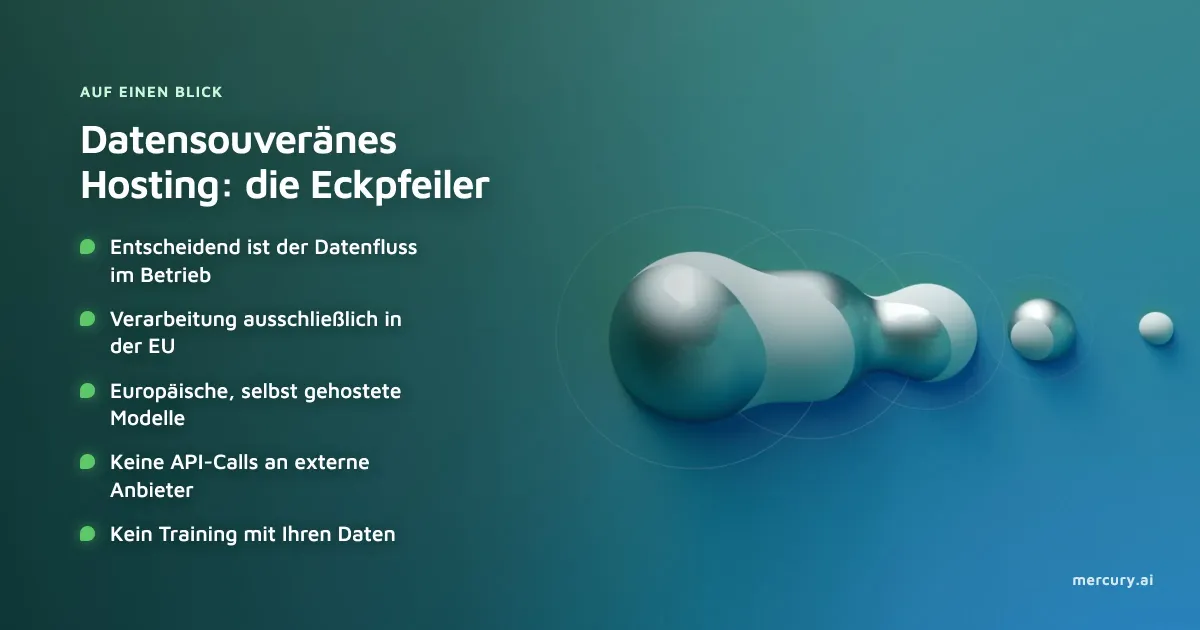
Data flow matters: A front end operated in Germany that calls a US API for every response is not data-sovereign.
Data flows to the US remain a legal risk: As soon as data enters the US, the CLOUD Act and FISA apply. The legal basis for transfers can fall away at any time.
Data sovereignty is created through architecture: EU hosting, European models, and no external API calls.
For regulated industries and the public sector, the data location is often an exclusion criterion.
What to look for: Processing location, infrastructure operator, data flows during operation, sub-processors, model hosting, encryption, and deletion concepts.
What "Chatbot Hosting in Germany" Really Means
"Made in Germany" on a website says very little about where your customer data ultimately ends up. An AI chatbot consists of several components—such as the front end, dialogue logic, knowledge base, and language model—and each of them can run in a different location.
True German hosting means that all components that process personal data run within the EU, including the language model. Many solutions host the interface and database in Germany, but pass the actual response generation on to a US provider via an API. At that moment, the content of the user request leaves the EU.
The decisive question to ask is therefore: Does any personal data leave the EU to answer a query? The server location alone is not an adequate answer.
Why Data Flows to the US Are a Compliance Risk
As soon as personal data is transferred to the US, companies need a robust transfer mechanism and bear the risk if its legal basis collapses. This is not a theoretical scenario. The legal framework for transatlantic data transfers has been overturned multiple times in the past.
In addition, there is the US CLOUD Act. It obligates US providers to disclose data even if it physically resides in Europe, as long as the company is subject to US law. For European data centers operated by US corporations, this remains a residual risk. How significant it is depends on what data is stored there, for how long, and how it is encrypted.
For banks, insurance companies, and the public sector, the data location is therefore often a deal-breaker in tender processes. Anyone who transfers operational data to services outside the EU risks being disqualified from the process right from the start.
Data Sovereignty Is Created Through Architecture
Contracts and assurances cannot fix an architectural problem. Data sovereignty is achieved when data technically cannot leave the EU in the first place. Three building blocks are essential for this:
Processing exclusively within the EU, including all sub-processors, with the shortest possible supply chain.
European, self-hosted models. The language model runs in the same EU environment as the other components, without API calls to external providers.
No use of customer data for training third-party models, contractually and technically excluded.
When these three points are met, the question of third-country transfers does not even arise.
Checklist: What to Look for in Chatbot Hosting
Processing location: Is all personal data processed exclusively within the EU?
Infrastructure operator: Does the data center belong to a US corporation? If so, how does the provider mitigate the CLOUD Act risk?
Operational data flows: Does the bot call external (US) APIs to answer queries? If so, what data is transmitted?
Model hosting: Does the language model run in the EU environment or with an external provider?
Sub-processors: How short and EU-centric is the list in the Data Processing Agreement (DPA)?
Encryption: Is data encrypted in transit and at rest? Are customer-managed keys supported?
Use for training: Are your conversations used for model training?
Deletion concept: Are retention periods configurable, and can users delete their data themselves?
These points also form the core of a GDPR- and EU AI Act-compliant AI chatbot. Hosting is just one of several critical building blocks.

How Mercury.ai Hosts
Mercury.ai is the Conversational AI platform from Germany, engineered for data sovereignty through architecture:
Processing exclusively in Germany. Mercury.ai operates the platform on AWS in Frankfurt. End-user data is processed exclusively there, with no transfers to third countries.
A single sub-processor (Amazon Web Services, Germany branch) keeps the processing chain short and DPA verification simple.
European, self-hosted models: Mercury.ai utilizes licensed, self-hosted, and fine-tuned Mistral models. There are no API calls to external providers; the data remains in Germany.
Encryption. Data is encrypted in transit and at rest, including backups. Keys are managed by AWS KMS with HSM; customer-managed keys are optional.
No training with customer data, no cross-client learning. Responses are generated exclusively from your verified sources.
Retention according to your specifications. Periods are fully configurable, ranging from immediately after input to the end of the contract.
Security: Multi-tenancy isolation, two-factor authentication, full audit logging, and regular penetration testing. The data centers used are ISO 27001-certified; Mercury.ai aligns with ISO 27001.
This leaves the CLOUD Act objection. AWS is owned by a US corporation, and Mercury.ai states this transparently. What keeps the risk minimal is provable: data never leaves Germany, no external AI provider receives conversation content, data is stored encrypted, and it is retained only for as long as you define. If this issue is critical to your project, we address it early and specifically.
That this model holds up even in highly regulated environments is proven by Volkswagen Bank, which uses Mercury.ai to automate recurring customer inquiries around the clock. To learn how the knowledge base and model architecture interact, read more under Mercury Intelligence. You can review our approach to the European AI regulation in the EU AI Act Security Whitepaper.
Frequently Asked Questions (FAQ)
Is it enough if the chatbot provider is based in Germany?
No. The company's headquarters says nothing about where data is actually processed. What matters is the real processing location of all components, including the language model, and whether data is transferred to third countries during operation.
Is a European data center of a US provider GDPR-compliant?
Generally, yes, provided the processing remains in the EU, a Data Processing Agreement pursuant to Art. 28 GDPR is in place, and no data is transferred to third countries. If the operator belongs to a US corporation, the CLOUD Act remains a residual risk. Therefore, verify additionally what data is stored, for how long, and how it is encrypted.
Mercury.ai runs on AWS. Isn't that still a US cloud?
AWS belongs to a US corporation, which is true. Mercury.ai operates the platform on AWS in Frankfurt and processes data exclusively there, without any transfer to third countries. The language models run self-hosted within the same environment; conversation content is never shared with external AI providers. Storage is encrypted, customer-managed keys are optional, and retention periods are defined by you.
What does data sovereignty specifically mean for an AI chatbot?
It means that data technically cannot leave the EU. Hosting, knowledge base, and language model run within an EU environment—without external API calls and without using your content for training.
Can we keep data in Germany and still use generative AI?
Yes. Generative AI can be operated using self-hosted European models. The generative component then solely formulates the response, while all processing remains in Germany.
Conclusion
When it comes to chatbot hosting, architecture is decisive. Those who rigorously assess processing location, data flows, model hosting, and deletion concepts achieve true data sovereignty and render the GDPR question of third-country transfers obsolete.
Would you like to know what data-sovereign chatbot hosting looks like for your organization? Talk to us or download the EU AI Act Security Whitepaper.
About the author: Dr. Maximilian Panzner is CTO and co-founder of Mercury.ai. He earned his doctorate in computer science at the CITEC Institute of Bielefeld University, conducting research on multimodal machine learning and intelligent interaction systems. For more than 20 years, he has been working on artificial intelligence, human-machine interaction, and conversational AI platforms for enterprise use.