


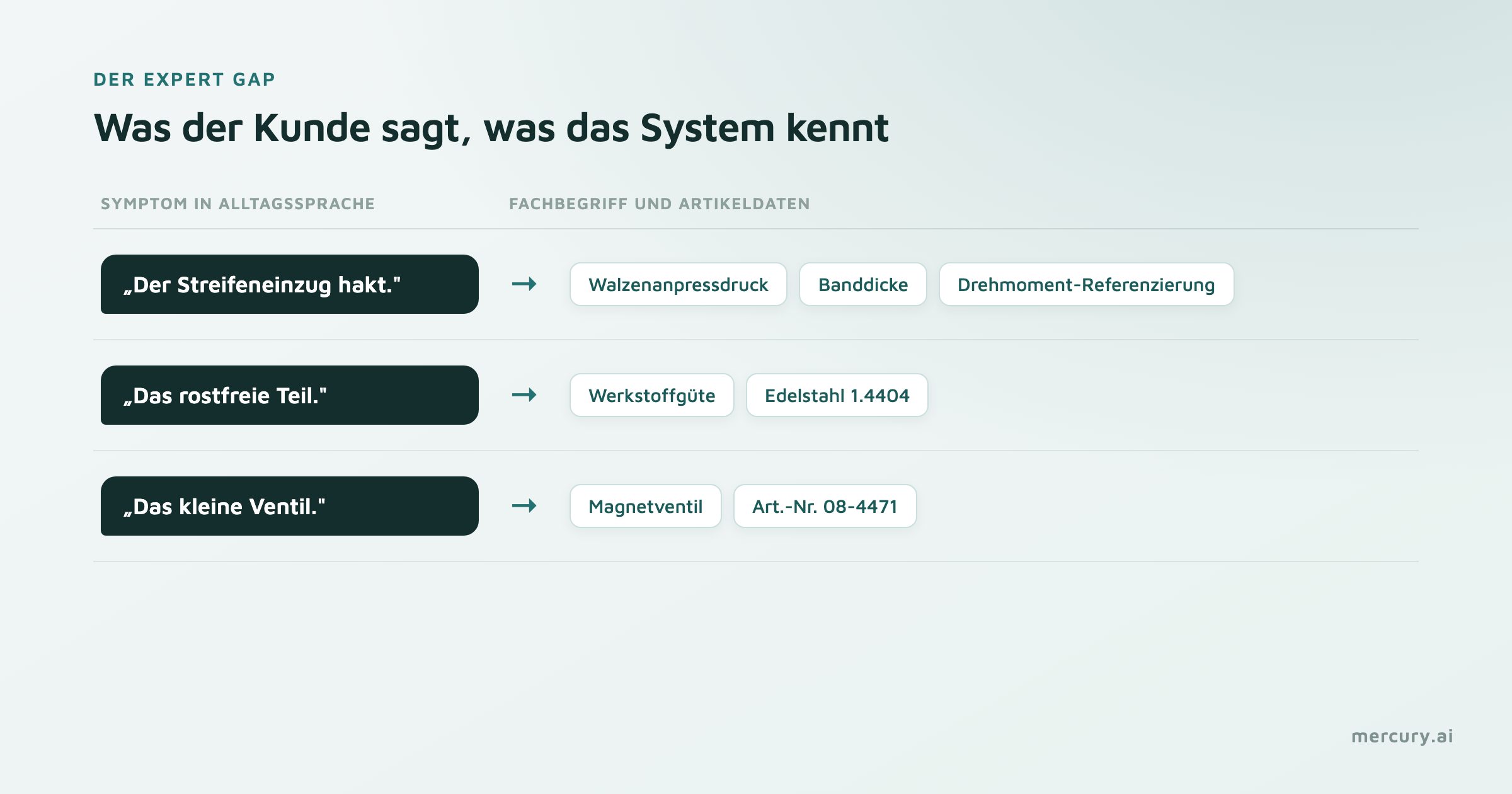
In the after-sales department of a machine manufacturer, the phone rings, and on the other end, a customer says: "The strip feed is jamming during the machine start-up." No part number, no technical term, just a symptom. The employee in first-level support has to formulate the right question from this: Is it about the roller contact pressure, the strip thickness, or the torque referencing. This translation is the actual work, and it is the point where industrial service comes to a halt every day.
In conversations with machine manufacturers, we see this pattern time and time again. First-level support is internally regarded as a cost center, yet the customer relationship in the most lucrative part of the business depends on it. According to an analysis by BCG, after-sales services in the industrial business achieve gross margins of 30 to 50 percent, while the sale of new machines stands at 15 to 25 percent. Service is where the money is made and the next order is prepared. And right there, the customer is waiting on hold.
In after-sales, the speed with which someone finds the right spare part decides the next order.
Three frictions that slow down first-level support
Anyone who observes industrial service sees the same three frictions, regardless of industry and product.
The first is the expert gap. Customers describe their problem in everyday language, while the company's knowledge is stored in technical terms. "The stainless part" means a specific material grade, "the small valve" is a solenoid valve with a part number. A gap yawns between what the customer says and what is in the product catalog and ERP, which is currently bridged by an experienced person asking follow-up questions.
The second friction is the knowledge leaving the company. Experience in mechanical engineering resides in just a few heads, and those heads are retiring. The DIHK-Fachkräftereport 2025/26 cites the shortage of skilled labor as the greatest business risk for more than half of all companies. Where knowledge is only passed on verbally, a Chinese whispers effect occurs. And with every departure, the information provided becomes thinner.
The third friction is the media disruption. The answer to a customer question is rarely in one place. It is scattered across a data sheet as a PDF, a spare parts list, the stock level in the ERP, and a note in the CRM. An analysis by Atlassian estimates the share of working hours spent searching for information at around one quarter. In service, this is the time the customer spends waiting.
What changes when first-level support is automated
An AI chatbot shifts the translation work from the human to the system without giving up the technical expertise. This succeeds when three things come together.
The bot links its answers to verified sources. The information comes from a verified data sheet, the ERP, or a test report, but not from the open language model. This ensures it remains reliable in a technical environment where an incorrect statement is costly. How this source binding works is explained in the article on hallucinations in AI chatbots.
The bot translates between symptom and technical term. Behind "the strip feed is jamming," it recognizes the technical attributes that narrow down the selection and guides the customer to the right part with targeted follow-up questions. This guided advice connects the dialog with the structure of the catalog, as described in the article on the digital product advisor.
The bot accesses real transaction data. Only the connection to ERP and CRM turns a general piece of information into a specific one: availability, price, delivery time, compatibility for the installed machine. How a chatbot connects to SAP, Salesforce, and HubSpot is shown in the article on CRM and ERP integration.
What remains is passed on to the subject matter experts. Complex cases, complaints, or decisions requiring discretion land with the service technician via an organized handoff, including the chat history. The Agent Desk keeps the context visible at a glance and enables the next steps.
An example from fastening technology
The Böllhoff case shows what this looks like in the industry. Since 2019, the specialist in fastening technology has relied on a chatbot from Mercury.ai to handle a complex B2B portfolio and the usual media disruptions in service. Customer inquiries run seamlessly without media breaks, and qualified leads are generated daily from the dialog, landing with the sales team via the Agent Desk. Johanna Neumann, Head of Marketing Europe, accompanies the project, whose next step is multilingualism for the international customer base. The detailed case study is available under Böllhoff.
The first level carries the customer relationship
Industrial after-sales decides on repeat purchases and recommendations, and it carries the best margin in the company. Automating it means delegating repetition to a system that understands symptom language, links answers to verified knowledge, and knows the real data. The experienced human remains where they are needed: on tricky cases and with the customer who needs a decision.
For machine manufacturers with a broad portfolio and distributed locations, this is the way to bring availability and technical expertise together. A foundation for this is provided in the guide on automating customer service with AI.
Would you like to relieve your after-sales team? Speak with us or take a look at the solution for customer service.
About the author: Mirco Schmidt is Chief Revenue Officer at Mercury.ai. He has more than ten years of experience in international and executive roles, including at the Volkswagen Group, Club Med, and the EQS Group, and holds a degree in Marketing Management from the FH des Mittelstands in Bielefeld. His focus areas are project management, marketing and sales, as well as communication.
Sources
BCG (2025): Aftermarket Services Drive Growth and Higher Margins for Industrial Manufacturers. After-sales gross margins of 30 to 50 percent compared to 15 to 25 percent in the new machine business.
DIHK-Fachkräftereport 2025/26: More than half of the companies see the shortage of skilled labor as the greatest business risk.
Atlassian (2025): State of Teams. Around one quarter of working hours is spent searching for information.