


A digital product advisor guides customers with targeted follow-up questions from the initial need to the matching product, even for large and complex product ranges requiring explanation. It bridges the gap between the everyday language of customers and the data language of the catalog. In B2B, exactly this translation determines whether an inquiry becomes an order or an expensive incorrect purchase. This article shows how Guided Selling with AI works and what matters during implementation.
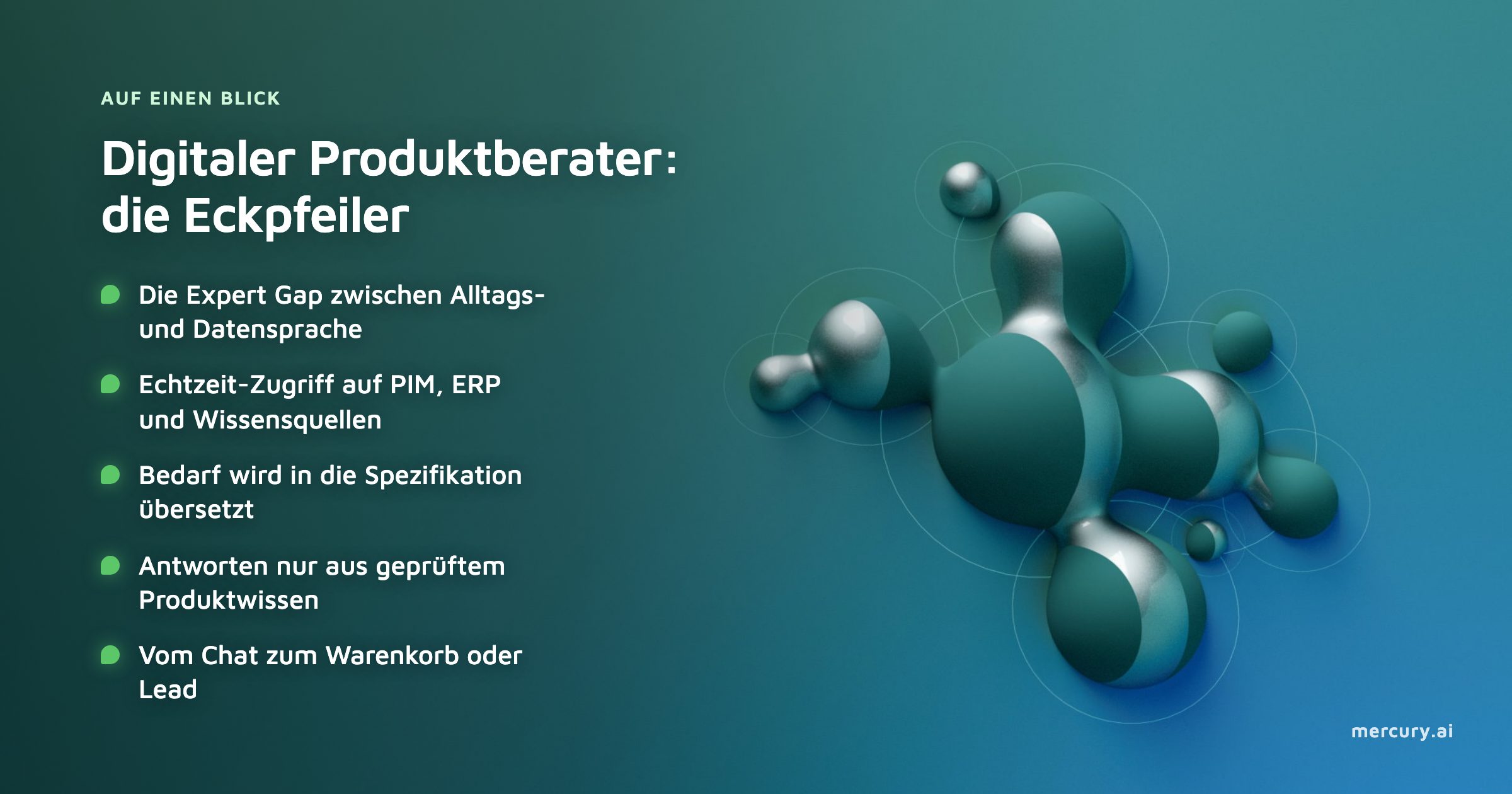
At a Glance
The Expert Gap: Customers speak everyday language, product data speaks the standard. This gap has previously been closed manually by specialists.
Three Success Factors: Real-time access to product data, translation of need into specification, dialogues through to conversion.
Answers solely from verified product knowledge.
From chat to results: add to shopping cart, initiate a quote, or hand over a qualified lead to sales.
In practice in use at Böllhoff.
The Problem: The Expert Gap
Customers describe their needs in their own words. Someone searches for "a glove that is acid-resistant". The product system does not know this phrasing. It knows "nitrile, EN ISO 374, AQL 1.5". Between the question and the matching part number lies specialist knowledge that has previously been contributed by people in sales or internal services.
This gap costs money. Inquiries end up in queues, every consultation ties up time, and misunderstood requirements lead to returns and downtime. According to the Salesforce State of Sales Report, sales teams spend only about 28 to 30 percent of their time actively selling. A large portion of the rest goes into research and recurring standard questions.
The Three Success Factors of Guided Selling
1. Real-time access to product data. A good product advisor works with the latest information. It accesses PIM, ERP, and approved knowledge sources directly via interface. This eliminates manual maintenance, and the information matches the real inventory. The page on Integrations shows what this connection looks like.
2. Translation of need into specification. The core of Guided Selling is translation. The AI takes an unstructured inquiry, derives filter criteria from it, and guides to the matching product using follow-up questions. Targeted questions turn "acid-resistant" into the correct material class and standard.
3. Dialogues through to conversion. A digital product advisor places the product in the shopping cart, initiates a quote, triggers a reorder, or transfers a qualified lead with full conversation history to sales via the Agent Desk.
Why a generic chatbot reaches its limits here
An open language model does not know your product range. It calculates plausible formulations from general world knowledge and easily gets technical details wrong. An incorrect standard specification or material recommendation quickly becomes a liability and return risk.
A reliable product advisor answers solely from verified product knowledge. A hybrid architecture separates the logic from the phrasing for this purpose. The facts come from your approved sources, the generative AI only handles the linguistic formulation, and the same question is followed by the same correct answer. This significantly reduces the risk of hallucination. How this works technically is described by Mercury Intelligence, and the knowledge base behind it by the Knowledge Hub. The article on the GDPR and EU AI Act-compliant AI chatbot explains how the entire process remains GDPR-compliant.

Böllhoff: Guided Selling in Practice
The Böllhoff case shows how this pays off in industrial B2B. The specialist in fastening technology has a complex portfolio and struggled with media breaks in consulting. With Mercury.ai, a product advisor answers inquiries seamlessly across media and hands over qualified leads to sales daily. A search query is thus transformed into a concrete sales contact.
Self-Test: Is a digital product advisor worth it?
The more often you agree here, the higher the efficiency:
Your range has many confusing variants.
Customers and employees use different terms for the same product.
Incorrect orders cause noticeable costs.
Recurring inquiries tie up a lot of time in sales.
Product information is structured but difficult to access.
The product choice can be logically derived, from parameter A to product B.
Agreeing more than three times clearly speaks for a digital product advisor. You can find a solution overview under Chatbots for Product Search and Consulting.
How Mercury.ai implements Guided Selling
Direct connection to PIM, ERP, and CRM, so the advisor works on up-to-date product data.
Orchestrated AI on verified knowledge, which translates need into specification and only provides proven answers.
Actionable dialogues with shopping cart, quote, and qualified lead hand-off.
No-code maintenance, so specialist teams can adjust dialogues and product logic without developers.
Data processing exclusively in the EU (AWS Frankfurt), suitable for regulated and security-conscious industries.
Frequently Asked Questions (FAQ)
What is the difference between a chatbot and a digital product advisor?
A simple chatbot answers questions. A digital product advisor actively guides through the selection, translates the need into concrete criteria, and leads to the matching product or lead hand-off.
Where does the product advisor get its knowledge?
From your approved sources such as PIM, ERP, and product documentation, connected in real-time. General world knowledge is kept out so that the recommendations are reliable.
Can the advisor also sell, or only inform?
It can complete transactions. Depending on the connection, it places products in the shopping cart, creates quotes, or hands over qualified leads to sales.
Is Guided Selling only suitable for retail?
No. Wherever products requiring explanation with many variants are advised, from industrial suppliers to technical wholesalers, a product advisor relieves sales and improves conversion.
Conclusion
Guided Selling turns a product search into guided advice. The crucial step is the translation of the customer's need to the correct specification, based on your verified product data. Anyone who automates this translation relieves sales, reduces incorrect orders, and improves conversion.
Would you like to find out how a digital product advisor maps your product range? Talk to us or download the Whitepaper on Guided Selling in B2B.
About the author: Dr. Hendrik ter Horst is CPO at Mercury.ai and has ten years of experience with AI and dialogue-based systems. He completed his doctorate in computer science at the CITEC Institute of Bielefeld University, focusing on machine information extraction and data processing. His focus is on translating complex requirements into reliable, practical applications.