


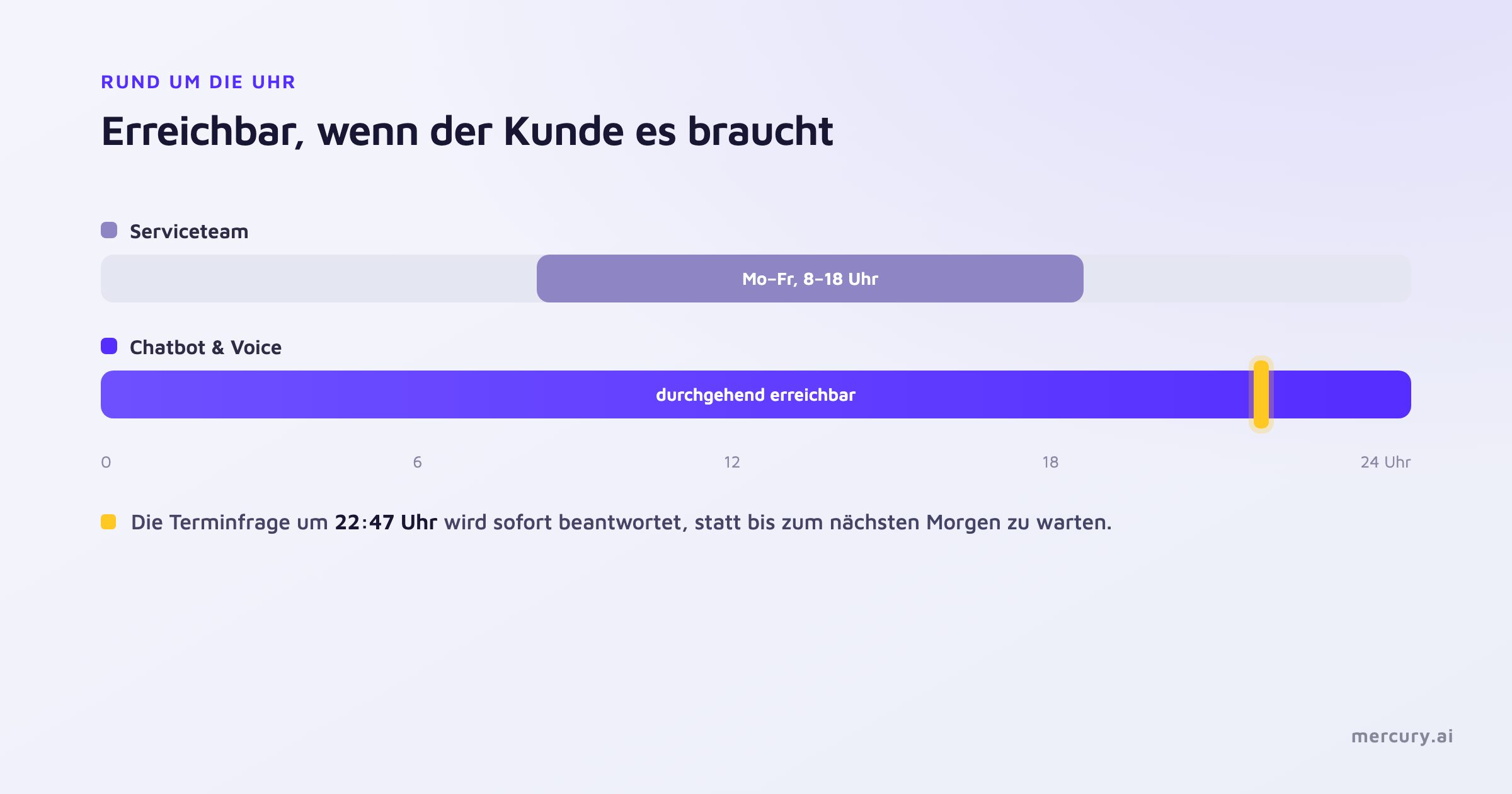
At 10:47 PM, a customer writes in the chat: "Which product is a better fit for me?" The service team has long since finished work for the day. Until the next morning, the question remains unanswered, and with it, the uncertainty. It is precisely during these off-peak hours that a decision is made as to whether a company appears accessible or whether customers are left alone with their concerns.
These off-peak hours are often not the exception. In our published case study of the EdTech provider Lexie, 60 percent of parents' inquiries were received in the evening or on weekends, which is when parents unwind after their daily routine. The expectation of constant availability has risen, and today more than half of consumers expect a response within an hour, regardless of the time.
Customers ask when it suits them
Classic service hours reflect the working day of the company, not that of the customer. Those who work during the day take care of their concerns in the evening, during their lunch break, or at the weekend. For industries with private customers, a large part of the volume shifts to precisely these times. Without a response at that moment, the query migrates to the queue the next day or directly to the competitor.
An AI chatbot closes this gap. It responds at any hour in the same quality, without waiting time, backed by the company's verified knowledge. The customer receives their information immediately, and the service team does not find a mountain of unanswered messages in the morning.
Which processes a chatbot handles after hours
Inquiries outside service hours are usually the same ones that fill the first tier during the day. A chatbot covers them independently:
Status information: Where is my delivery, what is the status of my transaction, when is the technician coming.
Appointments: booking, rescheduling, or canceling, with synchronization back to the calendar.
Master data: changing addresses, bank details, or contact information, with verified verification.
Recurring questions: conditions, opening hours, procedures for returns or complaints.
Initial intake: capturing a complex concern in a structured way and preparing it for the team in the morning.
What the bot cannot complete, it records systematically and presents to the appropriate employee with the full chat history. The customer still receives immediate feedback, and processing starts as soon as the team is back. The guide on automating customer service with AI shows which inquiries can generally be automated.
Also on the phone: Voice after hours
Accessibility does not end at the chat window. A large portion of customers still reach for the phone, where a call after hours is met with an announcement of the service times. A voicebot changes this. It answers the call in natural language, understands the request, and resolves standard cases like appointment booking or status inquiries independently, even at night and on weekends.
Mercury Voice brings this automation to the telephone channel, following the same source-bound architecture as the chatbot. In use, the channel shows up to 70 percent first-contact resolution in calls and an average call duration of around 45 seconds. This ensures the telephone line remains staffed even outside service hours. Read more in the article on the voicebot for customer service.
Turning availability into qualified leads
Accessibility outside service hours is more than a service; it is an opportunity for sales and after-sales. Anyone asking a product question in the evening is often close to a purchasing decision. A chatbot answers the question at the right moment, qualifies interest with targeted follow-up questions, and hands the contact over to sales.
In industrial B2B, our case with Böllhoff shows the impact: Qualified leads are generated daily from the dialog and land seamlessly with sales via the Agent Desk. What relieves the service team during the day continues to work as a silent sales channel at night. Every answered question outside service hours is a contact that would otherwise have been lost.
How Mercury.ai secures accessibility
Mercury.ai secures accessibility through a shared knowledge base to which chat, telephone, and messaging channels like WhatsApp connect. Every answer is bound to verified sources, so that information at 11 PM has the same reliability as in the morning. What a human should decide is handed over by the bot with context to the Agent Desk as soon as the team is reachable again. Data is processed in Germany, and maintenance is no-code. The page about the Platform provides an overview of the channels.
Frequently Asked Questions
Why is accessibility outside of service hours important?
A large portion of customers make contact in the evening, on weekends, or at night because that is when they have the time. Without a response at that moment, the inquiry moves elsewhere. A chatbot responds around the clock with consistent quality.
What inquiries can a chatbot answer at night?
The bot independently resolves status inquiries, appointments, master data changes, and recurring questions. It records complex inquiries and presents them to the team for the next morning.
Does accessibility also work on the phone?
Yes. A voicebot answers calls outside of service hours in natural language and resolves standard cases like appointment booking or status inquiries independently.
How do leads generate from availability?
Product questions outside of service hours often come from prospects ready to buy. The chatbot answers them, qualifies the interest, and hands the contact over to sales.
Does the response quality remain the same at night?
Yes. The answers come from verified sources, regardless of the time. With Mercury.ai, data is processed in Germany.
Accessible when the customer needs it
Service hours are an agreement a company makes with itself. The customer does not stick to them; they reach out when they have time and a concern. An AI chatbot and a voicebot turn this expectation into a strength: around-the-clock availability, a relieved team in the morning, and a sales channel that also works after hours.
Would you like to be reachable outside of service hours? Talk to us or take a look at our customer service solution.
About the Author: Dr. Hendrik ter Horst is Chief Product Officer at Mercury.ai. He holds a PhD in Computer Science from the CITEC Institute at Bielefeld University, focusing on machine information extraction and data processing. For ten years, he has been working on dialog-based AI systems and is responsible for the design, implementation, and validation of AI-supported applications from initial concept to productive use.
Sources
Mercury.ai Case Study Lexie / Sandfox Interactive: 60 percent of parent inquiries are received in the evening or on weekends.
HubSpot: Customer Service Statistics. More than half of consumers expect a response within an hour.