

A voicebot answers customer service calls using natural language, understands the inquiry, and resolves standard cases independently or hands them over to a human in an organized manner. For companies in Germany, two things matter: a telephone channel that is accessible without waiting times, and an architecture that brings data protection and voice quality together. This guide shows the use cases, the differentiation from classic telephone announcements, and the criteria for selecting a provider.
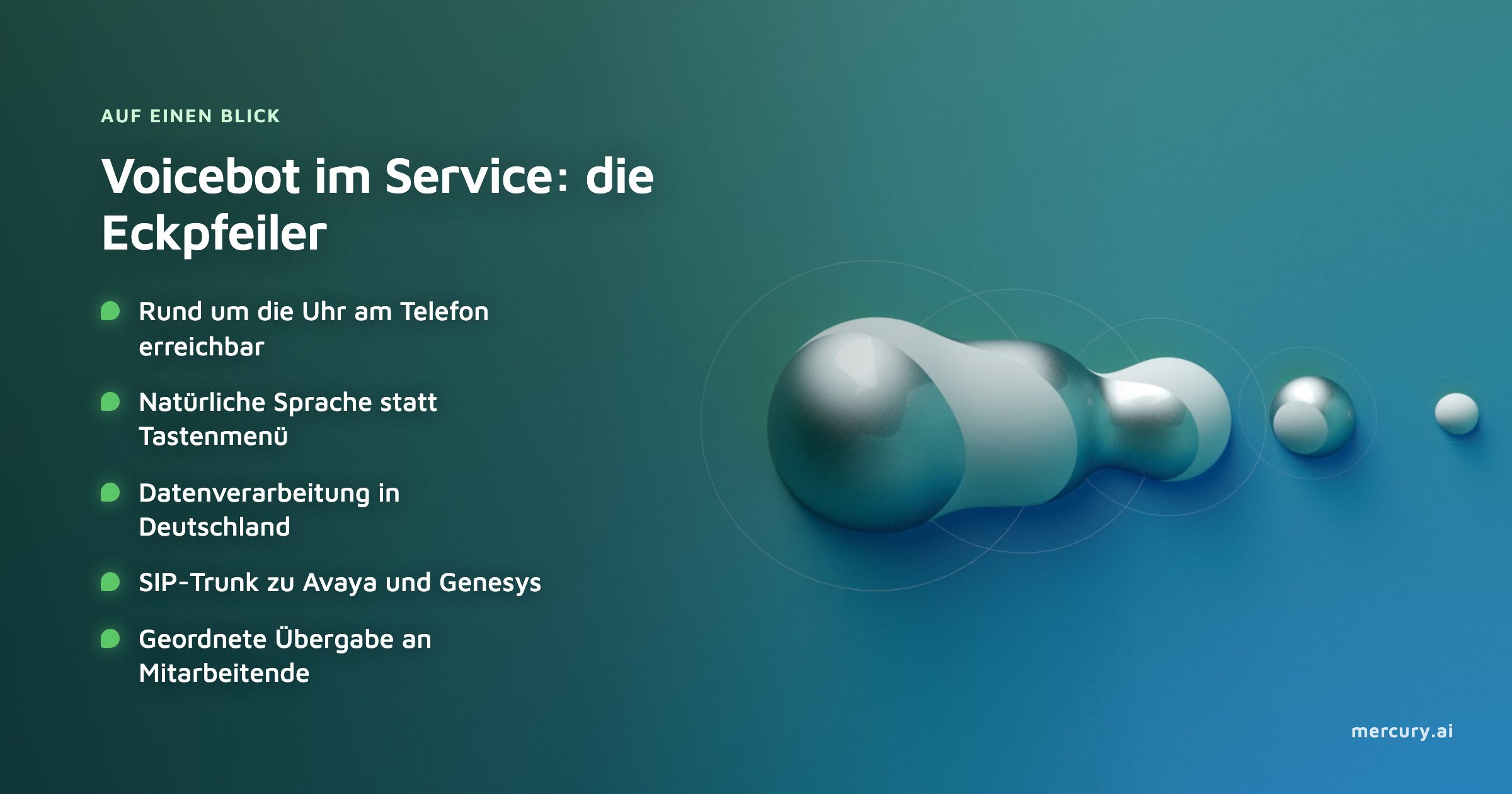
At a Glance
Around the clock on the phone: Standard inquiries such as booking appointments, status information, or address changes run automated, even outside of service hours.
Natural language instead of key menus: Callers state their request in their own words, and the voicebot also understands dialects and filler words.
Data processing in Germany, connected to existing telephone systems via SIP trunk.
Organized handover to employees as soon as a case requires context or a decision.
Channel switching during the conversation: from the call to a message with a link or document, without losing the thread.
Measurable impact: up to 70 percent fully resolved calls in use and a call duration of around 45 seconds instead of several minutes in the old menu.
What a Voicebot Achieves in Customer Service
A voicebot is a voice assistant for the telephone that connects Conversational AI with the telephone system. Callers describe their request freely, the system recognizes the intent and responds in spoken language. Unlike a recording with fixed announcements, the voicebot conducts a conversation, asks follow-up questions, and works with knowledge from the company's systems.
The benefit is evident in accessibility. A large portion of service calls concern recurring questions: Where is my delivery, how do I change an appointment, what documents do I need. A voicebot answers these cases immediately, without a queue. Employees gain time for inquiries that require experience and judgment.
Voicebot Instead of Classic IVR
The classic IVR works with a rigid menu and the prompt to press a key. Those who do not find their concern in the given structure end up in the wrong queue or hang up. A voicebot replaces the key menu with an open conversation.
The difference is felt in three areas. Callers speak freely instead of keying through levels. The system recognizes the request and directs without detour to the appropriate process. And call duration drops noticeably because the path to the answer becomes shorter. In practice, this leads to calls of around 45 seconds, where a menu-driven call takes several minutes.
Use Cases on the Phone
Voicebots are suitable for concerns that occur frequently and are clearly structured:
Status inquiries: Query delivery, order, transaction, or application status.
Appointments: Book, reschedule, or cancel, with synchronization to the calendar system.
Master data: Change address, bank details, or contact information, with verified verification.
Initial qualification: Record the request, categorize it, and forward it to the correct department.
Callback requests: Record and schedule outside of service hours.
For sectors with high call volumes such as retail, energy utilities, banks, or public administration, the voicebot covers a large part of the first level. What requires context or a decision is routed to a human.
What to Look for When Choosing a Provider in Germany
The market for voicebots has grown, and the offerings differ significantly in five points.
Data location. A voicebot processes call content, often with personal data. For the GDPR, where this data is stored is what matters. Processing in Germany without transmission to third countries is the robust path. Ask about the hosting location and the data processing agreement.
Architecture against hallucinations. On the phone, an incorrect answer is particularly noticeable because there is no visible source. Crucially, the answers must come from verified knowledge and not be freely invented by the language model. A system that binds its answers to the company's knowledge base delivers reliable responses. Learn more about this in the post on hallucinations in AI chatbots.

Telephony integration. The voicebot must connect to the existing telephone system. A SIP trunk to common systems such as Avaya or Genesys is the prerequisite for the bot going live without changing the infrastructure.
Voice quality and dialect. German callers speak with dialects, filler words, and self-corrections. A voicebot that understands this keeps the conversation flowing. Test recognition with real voices from your customer base.
Compliance proofs. For payment data on the phone, PCI-DSS is relevant. The EU AI Act requires that it remains recognizable that an AI system is speaking. A provider should be able to provide documented proof of these points.
How Mercury Voice Solves the Telephone Channel
Mercury Voice brings Conversational AI to the telephone, following the same architecture as the chatbot. An orchestra of specialized models recognizes the intent, checks the appropriate source, and only formulates the answer at the very end. The language model verbalizes; it does not decide on facts. This keeps the information bound to the company's verified knowledge.
The models used are licensed, self-hosted Mistral models. No API calls are made to external providers; the data remains in Germany. The voicebot connects via SIP trunk to existing systems such as Avaya or Genesys, supports payment processes according to PCI-DSS, and switches between telephone and messaging during the call. Mercury currently offers the voicebot in German and English, with other languages available upon request.
Mercury Voice is in its beta phase. In use, the channel shows up to 70 percent fully resolved calls and a call duration of around 45 seconds. A detailed overview is available on the Mercury Voice page.
Frequently Asked Questions
What is the difference between a voicebot and IVR?
An IVR works with a fixed key menu and pre-recorded announcements. A voicebot understands spoken language, conducts a conversation, and routes the request to the appropriate process without menu navigation.
Is a voicebot GDPR-compliant?
A voicebot processes personal data and is therefore subject to the GDPR. Operation becomes compliant through processing in the EU, a data processing agreement, and binding the answers to verified sources. With Mercury, the data remains in Germany.
How does a voicebot connect to the telephone system?
Via a SIP trunk to common systems such as Avaya or Genesys. This allows the voicebot to go live without altering the existing infrastructure.
Which languages does Mercury Voice support?
Currently German and English, other languages upon request. The chatbot covers up to 98 languages.
For which requests is a voicebot suitable?
For frequent, clearly structured cases such as status inquiries, appointments, master data changes, and the initial qualification of inquiries. The bot hands over complex requests to employees.
Conclusion
A voicebot makes the telephone channel accessible 24/7 and relieves customer service of recurring calls. For companies in Germany, the combination of data location, reliable architecture, and a stable connection to the telephone system is decisive. Mercury Voice brings these points together, following the same source-bound architecture as the chatbot.
Would you like to automate your telephone channel? Talk to us or take a look at Mercury Voice.