


Anyone deploying generative AI (GenAI) in customer service today is usually looking for a way to combine the linguistic power of large language models (LLMs) with the factual accuracy of their own data. The standard approach for this is called RAG (Retrieval Augmented Generation). However, those who deploy RAG systems in production customer processes without additional safeguards quickly realize: RAG systems solve a technical sub-problem, but they do not replace process logic, governance, or security architecture. This is exactly where many systems fail as soon as they are deployed under real-world service conditions with liability and SLA responsibility.
In this article, we analyze from a technological perspective why simple modular solutions fail when faced with complex service requirements and what an architecture must look like that not only finds knowledge but understands it procedurally.
The Fundamental Problem of LLMs in Service: Eloquent Answers Do Not Automatically Mean Competence
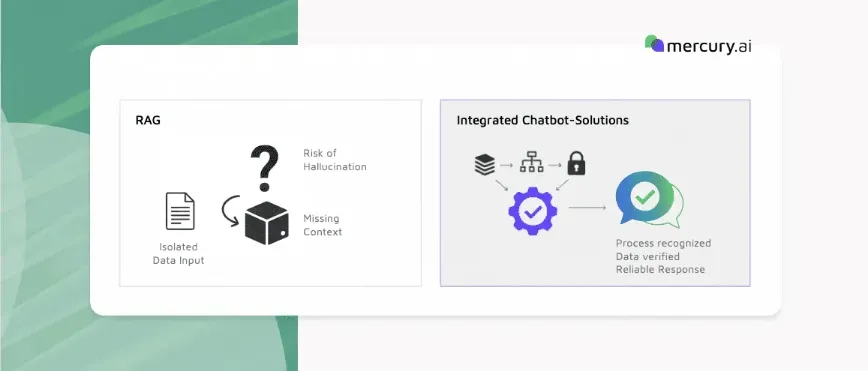
A Large Language Model (LLM) is primarily a statistical probability engine, not a knowledge database. It calculates word by word what sounds plausible. Without a controlled knowledge base, this inevitably leads to hallucinations. A chatbot then promises warranty periods, new product features, or displays outdated prices. RAG was supposed to solve this problem by providing the AI with an "open book" (your documents). But in the corporate environment – especially in industry or retail – simple "lookup" is not enough. Here, knowledge is not just a collection of facts, but consists of logic, causality, and context.
Technical Limitations of RAG in Customer Service
Many providers promise "chatting with your PDFs". The result is usually a digital scrap heap that fails at the first complex follow-up question. Mercury Intelligence therefore starts where most systems stop: at the preparation and cleaning of the database.
1. The Logic Problem: Causal Chains Instead of Text Snippets
Service knowledge is rarely linear. Fault diagnosis is a complex decision tree: "If the LED flashes red, check cable A. If cable A is intact, replace module B."
The Standard Error: Documents are bluntly divided into small text blocks ("chunks"). In the process, the logic is often torn apart. The AI does find the snippet "LED flashes red," but loses the connection to the crucial next step on the following page.
How Mercury.ai Solves It: We do not just process documents as text; we extract their structure. Our system identifies connected causal chains across page boundaries. The AI does not just receive text modules, but an understanding of the underlying process. Such an approach is crucial in the financial sector, for example. In the case of complex financing inquiries – for instance, in the automotive sector – it is not enough to quote FAQs. The system must map valid decision paths, check permissible product combinations, and take regulatory frameworks into account.
Decisions must be mapped in a rule-based, versioned, and audit-proof manner. In the financial sector, this means, for example:
Creditworthiness-dependent decision paths
Product- and term-specific term models
Consideration of regulatory requirements
Documentation obligation for every advisory recommendation
Exclusion of non-permissible product combinations

Volkswagen Bank uses this approach for process-reliable financing advice via chat.
Read the full customer story.
2. RAG Consistency Problem: Why Database and Governance Are Crucial
In grown corporate structures, knowledge has accumulated over years in different systems: a manual from 2020, an internal memo from 2022, and an up-to-date price list from 2026. Contradictory information often exists in these sources:
The Standard Error: RAG feeds the AI everything that semantically matches the question. The result: The AI hallucinates an answer from outdated and new data. For the customer, this creates the impression of a confident answer. In reality, it is based on a random mix of contradictory sources.
How Mercury.ai Solves It: An automated check mechanism detects discrepancies right during the data import and identifies contradictory information. We create a reliable database before the first customer query is even made. Quality in the answer begins with the hygiene of the source.

3. Why Semantic Search Alone Is Not Enough: Hybrid Search and Scientific Precision
As a spin-off from academic research at Bielefeld University and the Center for Cognitive Interaction Technology at Bielefeld University (CITEC), we know: A language model alone is not an information retrieval system. To meet enterprise requirements, we combine classic, mathematically proven methods with modern vector search.
The challenge in mechanical engineering, for example, lies not in the volume of data, but in its differentiation. Several thousand tools can exist in a single category - with dozens of variants per product: different diameters, coatings, cutting geometries, clamping systems, or material approvals. For a service employee, this means: They do not just have to find a product, but must identify the technically correct product in the right variant for a specific application.
Even small discrepancies in designation or specification lead to incorrect recommendations. A purely semantic search recognizes similarities, but cannot ensure that, for example, an almost identically named indexable insert with a different coating or geometry is excluded. In industrial environments, this is a cost and liability risk.
If two components have almost identical names but completely different specifications, a purely semantic search leads to chaos. Our solution is based on three pillars:
Classic Retrieval & Keyword Security: While modern vector search understands meanings, we use established methods such as BM25 to achieve a 100% hit rate for technical terms, serial numbers, and specific codes.
Knowledge Graphs for Context Integrity: We map facts and dependencies in knowledge graphs. If a user searches for information on a specific machine, the graph ensures that only context factually linked to this object is loaded.
Disambiguation through Clustering: When product names or technical terms sound similar but have different meanings, semantic search delivers incorrect results. This is a significant risk in automated knowledge processing. Through advanced clustering methods, we ensure sharp thematic differentiation.
4. The Security Architecture (Access Control)
By nature, a language model knows no hierarchies or confidentiality levels. It processes the information it is "fed" without considering the individual permissions of the person asking the question.
The Standard Error: If the AI has access to the entire knowledge pool, there is a risk of unauthorized information disclosure. An example of a concrete risk: If an end customer cleverly asks about discounts, an unsecured RAG system could simply reveal internal dealer purchase prices, merely because both pieces of information reside in the same search index.
Without access control, an AI system quickly becomes an internal data leak, regardless of how good the language model is. By default, a language model does not distinguish access rights.
How Mercury.ai Solves It: We separate search from generation using a strict rights system. Before a document fragment finds its way to the language model, a real-time check takes place: Does the user (e.g., guest, employee, or partner) have the necessary authorization for this specific source? The information is only used for the response upon explicit release.
5. Orchestration: Translating Knowledge into Action
Pure knowledge is of little use if no action follows. If a customer asks: "I want to cancel my subscription", a RAG system that quotes the cancellation period is of limited help.
Mercury Intelligence means dialogue orchestration. Our Mercury Intelligence acts as a central orchestrator to identify the intent behind the question:
Is it a knowledge question? -> RAG response based on cleaned data.
Is it a process? -> Handover to a deterministic flow that modifies data in the CRM securely and in compliance with GDPR.
We use generative AI where flexibility and naturalness are required. We rely on strict logic where processes must be reliable.
6. Data Protection and Sovereignty: Your Knowledge Remains in Your Hands
For European companies, the question of data sovereignty is not a side note, but an existential question. A critical point with many standard solutions is the unclear use of company data.
The Risk: With public LLM instances, there is a risk that inputs and document content will be used to train future model generations. Your proprietary expert knowledge thus involuntarily flows into the global data pool of the model operators.
How Mercury.ai Solves It:
We guarantee a strict separation of knowledge and model development.
Inference Instead of Training: We use your data exclusively as transient context for the generation of the respective response. The underlying AI model is never trained on real user interactions. Your intellectual property remains untouched.
European Hosting: The entire technology stack is operated on servers in Germany and Europe. This guarantees not only full GDPR compliance, but genuine digital sovereignty "Made in Europe".
Conclusion: From "Just Another AI Solution" to Strategic Infrastructure
Introducing AI in customer service is not a one-off project, but the building of a strategic infrastructure. Companies do not gain sovereignty through access to language models, but through the control over their own knowledge.
Mercury Intelligence combines:
Scientifically proven retrieval methods (e.g., BM25, vector search, etc.)
Structured knowledge through knowledge graphs
Enterprise-grade security architecture with granular access control
GDPR-compliant data processing in Europe
The result: A chatbot that does not just answer eloquently, but works reliably, securely in processes, and in compliance with regulations. And thereby creates a measurable reduction in workload for service teams.
Next steps: Find out in a non-binding conversation how much time your service team would save if customer queries were answered automatically and reliably.


