


Generic AI tools such as ChatGPT are not readily suitable for processing personal customer data in their standard form. Inputs are frequently processed outside the EU, a data processing agreement (DPA) is missing by default, and the answers are not tied to your verified sources. For GDPR-compliant customer service, a controlled, EU-hosted, and source-tied solution is therefore required.
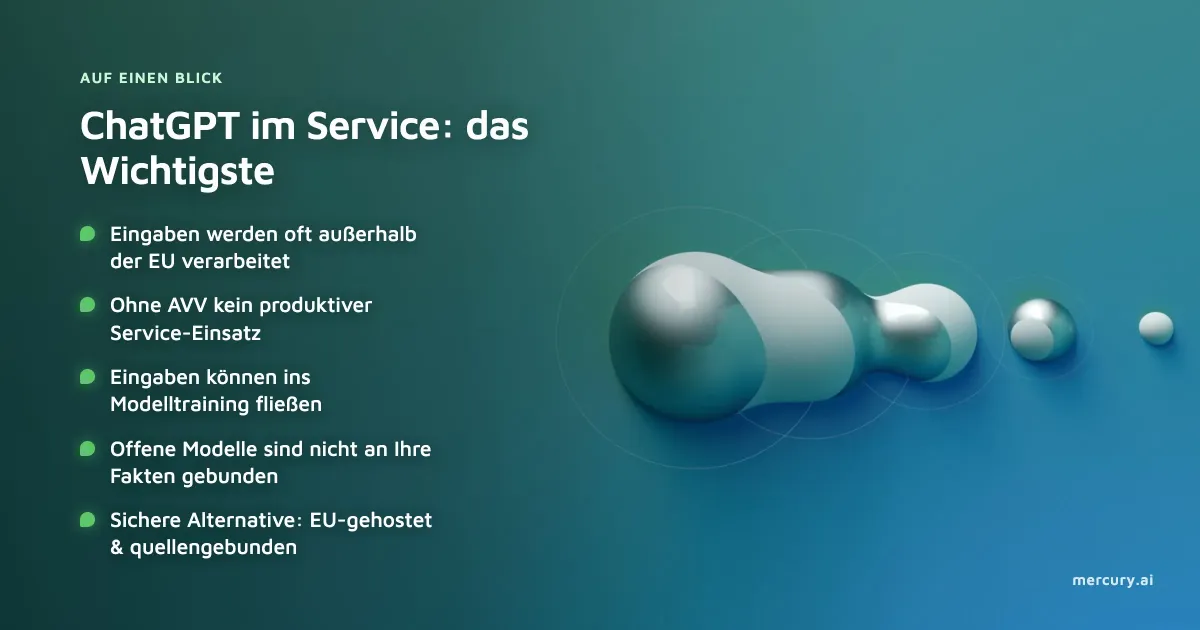
At a glance
Data Location: Inputs into generic AI tools are often processed in the USA, a third-country transfer with legal risk.
Data Processing Agreement: Productive service use requires a DPA according to Art. 28 GDPR; this is missing in freely used tools.
Training Use: Without the appropriate configuration, inputs can be used for model improvement.
Hallucinations: An open model is not bound to your facts and can generate incorrect information, presenting a liability risk.
The Solution: an EU-hosted, source-tied Conversational AI platform.
Why companies ask this question in the first place
In many companies, ChatGPT has long been part of everyday work, often faster than IT could authorize it. Employees use it for phrasing, research, and sometimes for customer inquiries. This leads to a double-edged problem. On the one hand, personal data may enter a tool without a contractual basis. On the other hand, answers circulate that sound plausible but do not comply with internal rules, "but then that's not the case at all."
This shadow IT is the trigger for the compliance question. Anyone wishing to answer it must separate two things: what generic AI tools can deliver and what customer service legally requires.
The four GDPR sticking points with generic AI in service
1. Data location and third-country transfer. Inputs into publicly hosted AI tools are frequently processed in the USA. As soon as personal data lands there, a third-country transfer occurs, requiring a resilient mechanism that is often unacceptable for regulated industries.
2. Data Processing Agreement (Art. 28). For productive use in customer service, a data processing agreement with clearly named sub-processors is required. This foundation is missing for tools used freely and without a corporate contract.
3. Training Use. Without appropriate settings or contract levels, inputs can be used to improve the models. For confidential customer data, this represents a loss of control.
4. Accuracy of Information. An open language model generates answers based on probabilities and is not bound to your verified sources. Incorrect information, for example regarding deadlines or conditions, can violate information duties and trigger liability.
These points are the same ones that define a GDPR- and EU AI Act-compliant AI chatbot. An open chat tool does not meet them by default.
In addition to data protection, the knowledge base counts
Generic AI responds from a broad, general world knowledge. In customer service, however, you need answers from your verified knowledge: from your tariffs, instruction manuals, contract terms, and processes. ChatGPT does not know these internal sources and fills gaps with the most probable formulation.
This is precisely where a hybrid architecture comes in. It separates the logic from the phrasing. The facts originate exclusively from your approved sources, while the generative AI only handles the linguistic formulation. If the system does not find an evidenced answer, it hands the case over to a human in a controlled manner. This significantly reduces the risk of hallucination and makes every answers traceable to the source. Read more about this under Mercury Intelligence and in the Knowledge Hub.

What a GDPR-compliant service chatbot looks like
A compliant solution establishes the right prerequisites from the ground up:
Hosting exclusively in the EU (at Mercury.ai: AWS Frankfurt, entirely in Germany), no third-country transfer.
European, self-hosted models without API calls to external providers, data remains in Germany.
No training with your data, clear DPA, configurable deletion periods, and user self-delete.
Source-tied answers with handover to humans in case of uncertainty.
Transparent AI labeling towards users, as required by the EU AI Act.
This way, the comfort of generative AI can be utilized without giving up control over data and statements.
Frequently Asked Questions (FAQ)
Am I allowed to use ChatGPT in customer service?
For processing personal customer data, the freely used standard version is generally not suitable. EU data residency and a data processing agreement are missing. Business variants offer more controls, but mostly still process data outside the EU. For regulated industries, an EU-hosted, source-tied solution is the safe way.
Are my inputs used for training in ChatGPT?
That depends on the version and settings. Without active configuration or an appropriate contract level, inputs can be used for model improvement. For confidential customer data, training use should be contractually and technically excluded.
Why does ChatGPT sometimes make up answers?
Because an open language model generates answers from probabilities and is not bound to your verified sources. A hybrid architecture that sources facts from approved references significantly reduces this risk.
What is the GDPR-compliant alternative to ChatGPT in service?
An EU-hosted, source-tied Conversational AI platform that uses generative AI only for formulation, does not use customer data for training, and informs users transparently about the use of AI.
Conclusion
Generative AI has long since arrived in customer service. The crucial factor is that it occurs under control. Plausible-sounding answers need a tie to verified sources, and a practical tool needs a legal foundation. Those who clarify data location, data processing, training use, and source binding replace shadow IT with a robust solution.
Would you like to bring generative AI into your customer service in a legally secure manner? Talk to us or download the EU AI Act Security Paper.
About the author: Dr. Maximilian Panzner is CTO and co-founder of Mercury.ai. He holds a PhD in computer science from the CITEC Institute at Bielefeld University, where he conducted research on multimodal machine learning and intelligent interaction systems. For over 20 years, he has been working on machine learning, human-machine interaction, and dialogue-oriented AI platforms for corporate use.