

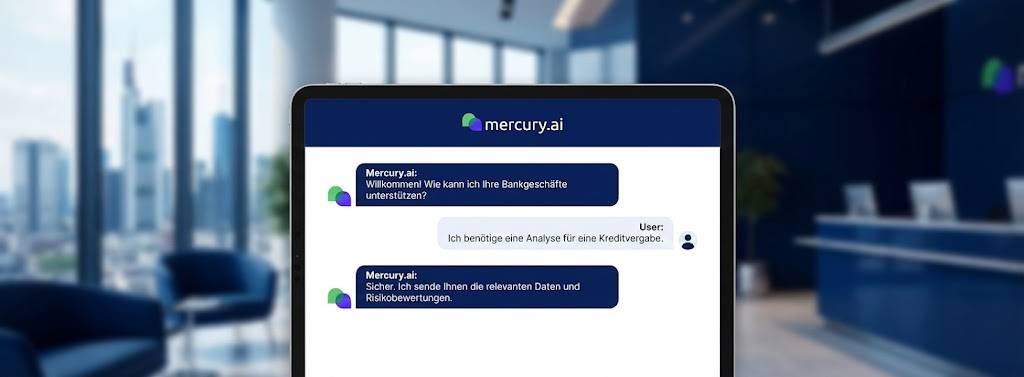
Banks, insurers, and financial service providers face a dilemma: customer expectations for 24/7 availability and instant answers are rising exponentially. At the same time, strict regulatory requirements (BaFin, GDPR, internal compliance) leave little room for experimentation with "creative" AI. Simply "doing something with AI" is not advisable.
Traditional channels such as phone and email are cost-intensive and difficult to scale. However, generic AI solutions that are simply built on tools like ChatGPT fail when it comes to the most vital currency in the financial sector: reliability.
The Mercury.ai Conversational AI platform resolves this conflict. By combining controlled knowledge sources with generative AI, we enable automation without the "black-box risk".
The Risk of Generic AI in the Financial Sector
Customer interactions in banking and insurance are almost always transactional and sensitive. They involve account balances, identification procedures, claims reporting, or contract details.
Generic large language models (LLMs) are trained to sound plausible, not necessarily to be correct. In a regulated environment, this can have fatal consequences.
Inaccuracies: The AI fabricates terms, conditions, or rates.
Lack of Traceability: It is unclear on which database an answer was generated.
Data Privacy Risks: Server locations outside the EU often violate compliance requirements.
For financial service providers, such "creative" AI is not an option. They require a deterministic system.
Mercury Intelligence: Deliberate Orchestration Instead of Coincidence
Mercury.ai does not rely on a single model, but on an orchestrated AI architecture. This means: before a question is answered, various systems and experts work together to formulate a response: first it is understood, then it is answered.
1. Segregated, Verified Knowledge Sources
Mercury.ai utilizes Mercury Intelligence to generate responses exclusively based on your verified documents, guidelines, and PIM data.
No World Knowledge: The bot does not access unfiltered internet sources.
Source Precision: Every answer is traceable down to the document version.
Secure Fallback: If no validated information is available, the system does not fabricate anything; instead, it hands over in a controlled manner to the service team.
2. Transactional Workflows Instead of Just "Chatting"
In banking, just "talking" is not enough, because customers want immediate results for their inquiries and requests. Mercury.ai integrates deeply into your backend systems (CRM, ERP, core banking systems).
The chatbot becomes a service automation tool:
Address changes and SEPA mandates
Blocking and unblocking cards
Initiating identification processes (e.g., VideoIdent, eID)
Status inquiries on claims
…
3. Enterprise Compliance & Hosting in Germany
Data sovereignty is non-negotiable for financial service providers. Mercury.ai is hosted entirely in the EU and operates without dependencies on third-party US providers such as OpenAI. The system is designed with "Privacy by Design" principles and is GDPR-compliant.
Practical Example: Identification & Authentication in the Chat Channel
A chatbot in banking can do more than serve as an FAQ tool. It acts as a project manager for complex processes:
Intent Recognition: The customer types "I need a new account".
Context Check: The bot checks (via API) whether the customer is already registered.
Process Control: The bot initiates the appropriate KYC process (e.g., forwarding to IDnow or PostIdent) and transfers the required parameters.
Handover: In the event of an abort or ambiguity, the bot seamlessly hands over the context to a human agent in live chat.
Case Study: Efficiency Leap at Volkswagen Bank
Volkswagen Bank GmbH has been successfully using Mercury.ai to automate its customer service since 2018.

Challenge: High volume of standard inquiries regarding online banking, photoTAN, and contract details.
Solution: An AI chatbot deeply integrated into the knowledge base that pre-qualifies complex inquiries.
Result: Significant relief for the contact center, 24/7 availability, and noticeably increased customer satisfaction.
"Thanks to Mercury.ai, we can provide our customers with answers to a wide range of recurring questions around the clock. The increase in customer service efficiency achieved through the AI chatbot is remarkable."
— Achim Schwörke-Lukasik, Specialist for Digital Inbound Channel Management, Volkswagen Bank GmbH
Conclusion: Why Banks Need a Specialized Platform
Today, the market distinguishes between "consumer AI" and "enterprise AI". For banks and insurers, the requirements are clear:
Requirement | Solution with Mercury.ai |
Security | Hosting in Germany, no use of customer data for AI training. |
Precision | Answers generated only from linked sources; hallucinations significantly reduced. |
Integration | Seamless connection to backend systems for real transactions. |
Control | Business departments manage content via no-code, while IT maintains sovereignty over security. |
About the Author
Dr. Maximilian Panzner
Chief Technology Officer @Mercury.ai
Dr. Maximilian Panzner is CTO and co-founder of Mercury.ai. He earned his doctorate in computer science at the CITEC institute of Bielefeld University, where he conducted research on multimodal machine learning and intelligent interaction systems. For over 20 years, he has been working on artificial intelligence, human-machine interaction, and conversational AI platforms for enterprise use.