

AI chatbots hallucinate because a language model calculates the most probable phrasing rather than accessing verified knowledge. This can be avoided by tying the answer to verified sources. Retrieval-Augmented Generation (RAG) grounds the response in real data, a hybrid architecture additionally separates the logic from the phrasing, and if a source is missing, a human takes over. This significantly reduces the risk of hallucination, and every response remains traceable.
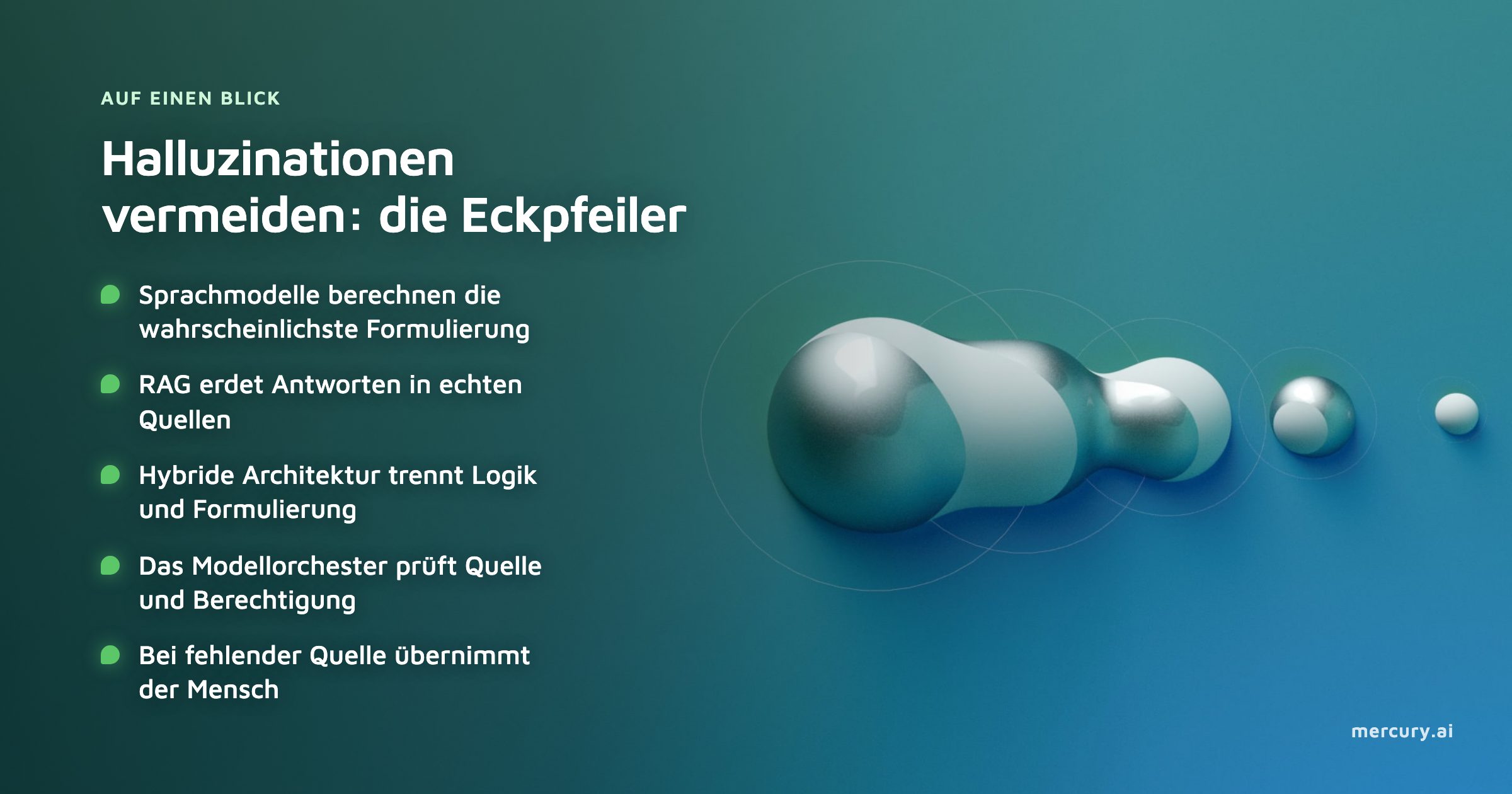
At a Glance
Cause: Language models calculate the most probable phrasing; they do not know the facts.
RAG: grounds responses in real, retrieved sources.
Hybrid Architecture: separates the logic from the linguistic formulation.
Model Orchestra: experts, interpreters, and moderators verify source and authorization.
Safety Net: If the system cannot find a documented answer, it hands over to a human.
Why AI Chatbots Hallucinate in the First Place
A large language model is a probability model for language. It predicts the next word that best fits the context. This capability makes it strong in formulation and weak in facts. If information is missing, the model fills the gap with the most plausible variant. The result sounds convincing and is sometimes incorrect.
In customer service, this carries heavy consequences. A made-up delivery time, an incorrect contract clause, or an inaccurate standard specification costs trust and can trigger liability. The answer to the hallucination problem therefore lies in the architecture surrounding the model.
RAG: The First Step
Retrieval-Augmented Generation connects the language model to a knowledge source. Before generating a response, the system retrieves relevant content from a database or document collection and provides it to the model as context. The response is then generated based on these retrieved facts.
RAG is a major step forward, but it has limits. If the wrong passages are retrieved or the knowledge base is unstructured, errors can still occur. Why standard RAG often falls short in customer service is explored in depth in the article Kundenservice durch Tiefe.
Hybrid Architecture: Separating Logic and Phrasing
A hybrid architecture goes a step further. It separates two tasks that a pure language model mixes together: the question of what is correct, and the question of how it is formulated. The facts and rules originate from verified, restricted sources. The generative AI only handles the linguistic formulation. This keeps control over the content within the verified knowledge base while maintaining a natural-sounding response.
The difference between a pure language model agent and this approach is fundamental. Read more about this in the article KI-Agenten und Hybrid-Architektur.
The Model Orchestra: Experts, Interpreters, Moderators
Mercury.ai implements this idea with an orchestrated interplay of several model types, known as the Model Orchestra:
Experts retrieve the appropriate knowledge from the authorized sources.
Interpreters understand the request and its intent.
Moderators control the workflow, check authorization and source, and decide whether an answer is substantiated.
These roles work together and verify the response collectively. The same question leads to the same correct answer because the logic remains traceable. How this works in detail is shown in Mercury Intelligence.

Source Grounding and Controlled Handoff
The most effective protection against hallucinations is source grounding. Answers are generated exclusively from curated corporate knowledge, such as product data, contracts, and processes in the Knowledge Hub. Open-world knowledge is excluded, and every statement is traceable back to its source, document version, and rule.
Just as important is the behavior at the limits of knowledge. If the system does not find a verified answer, it does not guess. It hands over the case in a controlled manner to a human, along with the full conversation history. This safety net prevents a knowledge gap from turning into fabricated information.
Why This Is Also a Compliance Issue
Reliable answers are not just a convenience feature. Incorrect information can violate information duties, and the EU AI Act requires traceability and effective human oversight. An architecture that grounds answers in sources and hands off when uncertain directly addresses these requirements. Read about how data protection and the EU AI Regulation work together in our article on the DSGVO- und EU-AI-Act-konformen KI-Chatbot.
Frequently Asked Questions (FAQ)
What does hallucination mean in an AI chatbot?
A hallucination is an answer that sounds plausible but is factually incorrect. It happens when a language model fills a knowledge gap with the most likely phrasing without accessing a verified source.
Is RAG enough to prevent hallucinations?
RAG significantly reduces the risk because answers are grounded in real sources. However, if the knowledge base is unstructured or passages are retrieved incorrectly, errors are still possible. A hybrid architecture with source verification and human handoff goes further.
Can hallucinations be completely ruled out?
A residual risk remains with any generative AI. However, through source grounding, a verified knowledge base, and controlled handoff to humans, this risk can be significantly reduced, making every response traceable.
What is the difference between RAG and a hybrid architecture?
RAG provides the language model with retrieved facts as context. A hybrid architecture additionally separates the factual logic from the phrasing, ensuring that control over content remains with the verified knowledge base.
Conclusion
Hallucinations can be controlled through the right architecture. By tying responses to verified sources, separating logic from phrasing, and handing over to a human when uncertain, you turn a creative language model into a reliable conversational partner. This is precisely the core of a resilient enterprise AI chatbot.
Would you like to see what reliable answers look like in your company? Sprechen Sie mit uns or discover Mercury Intelligence.
About the Author: Dr. Maximilian Panzner is CTO and co-founder of Mercury.ai. He holds a PhD in computer science from the CITEC Institute at Bielefeld University, where he conducted research on multimodal machine learning and intelligent interaction systems. For over 20 years, he has been working on conversational AI, human-machine interaction, and enterprise-grade conversational AI platforms.