


Everyone is talking about AI agents: autonomously calling tools, querying data, making decisions. This sounds like the next evolutionary step of Conversational AI. In real customer dialogues, however, the limitations quickly become apparent: agents are probabilistic, do not always behave the same way given identical input, and can "compound" errors if an intermediate step goes wrong. This is precisely why they perform strongly as an exploration tool, but are not (yet) suitable as the sole basis for productive chatbots and AI chatbots. Studies and practical reports confirm: non-determinism, compounding errors, and tool dependencies are the central stumbling blocks.
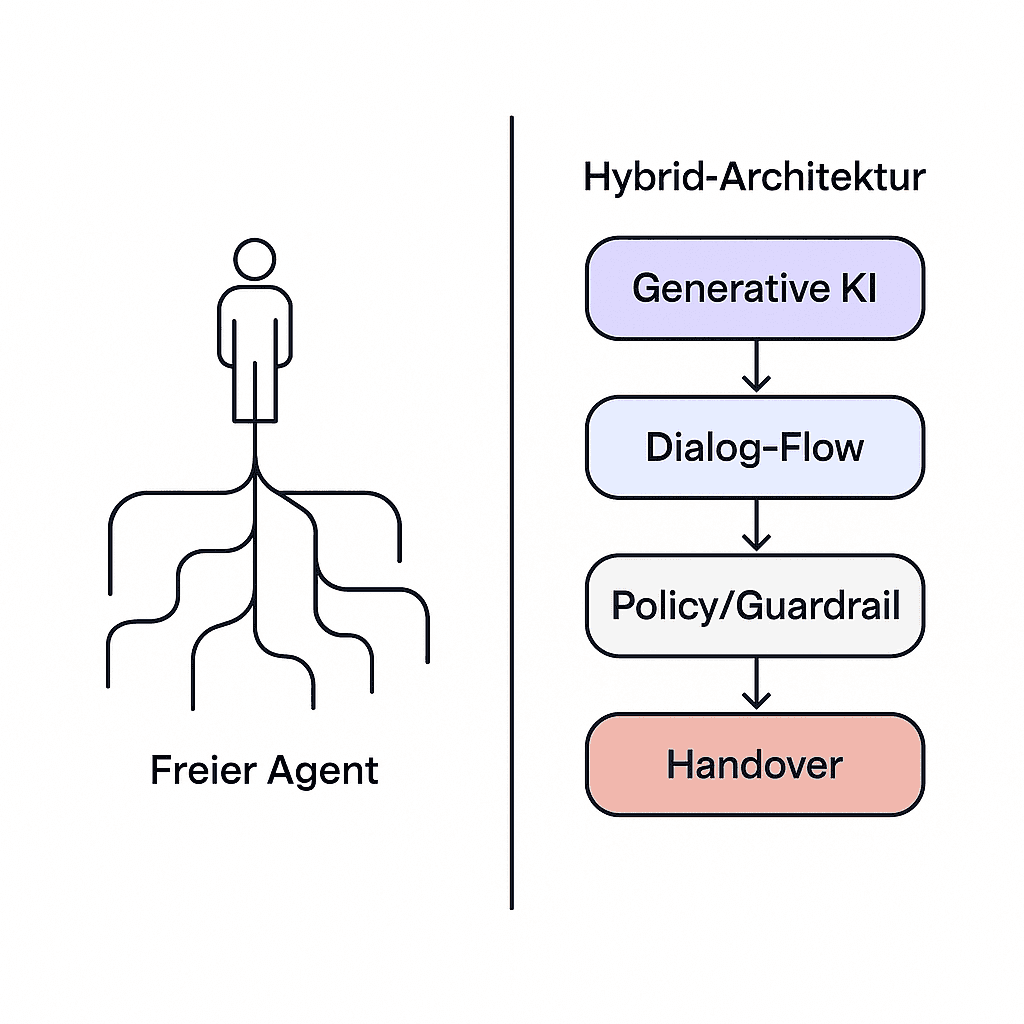
The Core Problem with AI Agents: Probabilistic Decisions Without Guardrails
Why do agents slip into uncertainty so quickly in productive Conversational AI scenarios? What are the challenges when deploying agents?
Non-determinism: Same input, different result; reproducible quality is difficult. In long chains, small deviations amplify into major errors (compound error).
Prompt/Context Drift: With every action, the semantic context shifts – the original task becomes blurred, instructions drift.
Tool Fragility: Small API changes or response variations lead to loops or misinterpretations; without strict validation layers, stable contracts are missing.
Compliance Risk: Even low error rates generate many incidents at high volumes – unacceptable in regulated environments.
The Mercury Approach: Hybrid Conversational AI Beats Hype
The Conversational AI platform from Mercury relies on a hybrid architectural approach:
Generative AI provides language understanding, context interpretation, and natural framing. Deterministic dialogue and workflow engines provide structure, traceability, and compliance – plus clean handover paths to the team.
This creates AI chatbots that remain flexible but act reproducibly: capable of learning and auditable. Precisely this combination is also recommended by engineering guides: evals/guardrails, RAG control, and deterministic flows where commitment matters.
Conversational AI Platform Features: Dialog Flows, Conversation Analytics, Chat Inbox
Controlled GPT-Q&A (RAG): GPT Question Answering
Channels & Entry Points: Chat Widget, Multi Channel Messaging
Agent-only vs. Hybrid in Practice
Criterion | Agent-only (purely generative) / AI Agents | Hybrid (Gen AI + deterministic flows) |
|---|---|---|
Determinism | Low; results vary | High; same input → same behavior |
Error Propagation | High (compound error) | Low; gateways & validations |
Governance/Compliance | Difficult to audit | Clearly defined policies & approvals |
Tool Robustness | Fragile during API drift | Typing/contracts, fallback paths |
Time-to-Value | Fast in prototyping | Fast in production (pre-configured flows + AI) |
Scaling | Unpredictable | Predictable (SLAs, monitoring, handover) |

Guardrails, RAG & Evals: Three Building Blocks for Reliable Conversational AI
Guardrails & Policies: prohibited actions, tonality, response length, PII handling; deterministic "saying-no" paths. (Industry guidelines emphasize auditability & explainability.)
RAG with Approvals: answers only from curated sources; versioning & testing.
Evaluation (E2E & Step-wise): scenarios, gold responses, tool checks; without evals, agents remain unreliable.
What Makes AI Agents Additionally Risky: Explained Briefly
Prompt Drift & Chaining: the task becomes blurred in long chains; test early, constrain tightly.
Adversarials & Injections: agents can be lured into loops/incorrect paths – strict stop criteria & tool safeguards required.
The Scaling Paradox: a 1% error rate sounds small – at 50,000 cases/month, that means 500 risks. Governance is mandatory.
Quick-Start: How Do I Start with Conversational AI? (4 Steps, 30–45 Days)
Define Scope: A clear use case (e.g., WISMO).
Implement Hybrid: Generative AI chatbot + predefined dialogue flows + RAG.
Establish KPIs: CSAT, FCR, AHT, drop-out rate; monitoring in Conversation Analytics.
Test Fallbacks: response uncertainty → RAG; rules required → flow; complex → handover.
See it live now: Book a demo – We will show you your flow and an initial chatbot.
Legal & Trust in Your Conversational AI Platform: GDPR, Data Sovereignty, Made in Germany
Mercury processes data in compliance with GDPR, with clear roles, retention periods & approvals. Control remains within the enterprise; content does not flow into external training pools. External guidelines on deterministic flows in regulated scenarios underscore the "Gen AI + deterministic control" approach.
Conclusion
Agents are brilliant for experimentation, but too risky as a sole architecture. The combination of Generative AI (flexibility) and deterministic dialogue flows (reliability) makes a Conversational AI platform production-ready: auditable, scalable, and compliant with GDPR. This is exactly what Mercury delivers: chatbot & AI chatbot with guardrails, RAG, and evals. For conversations that work and deliver results.


