


An AI chatbot in e-commerce answers standard inquiries around the clock, guides customers through product selection, and takes pressure off the service team, especially during peak loads. In online retail, it works on two levels: it relieves customer service and supports conversion. This article shows the most important use cases, the appropriate channels, and what matters for reliable answers.
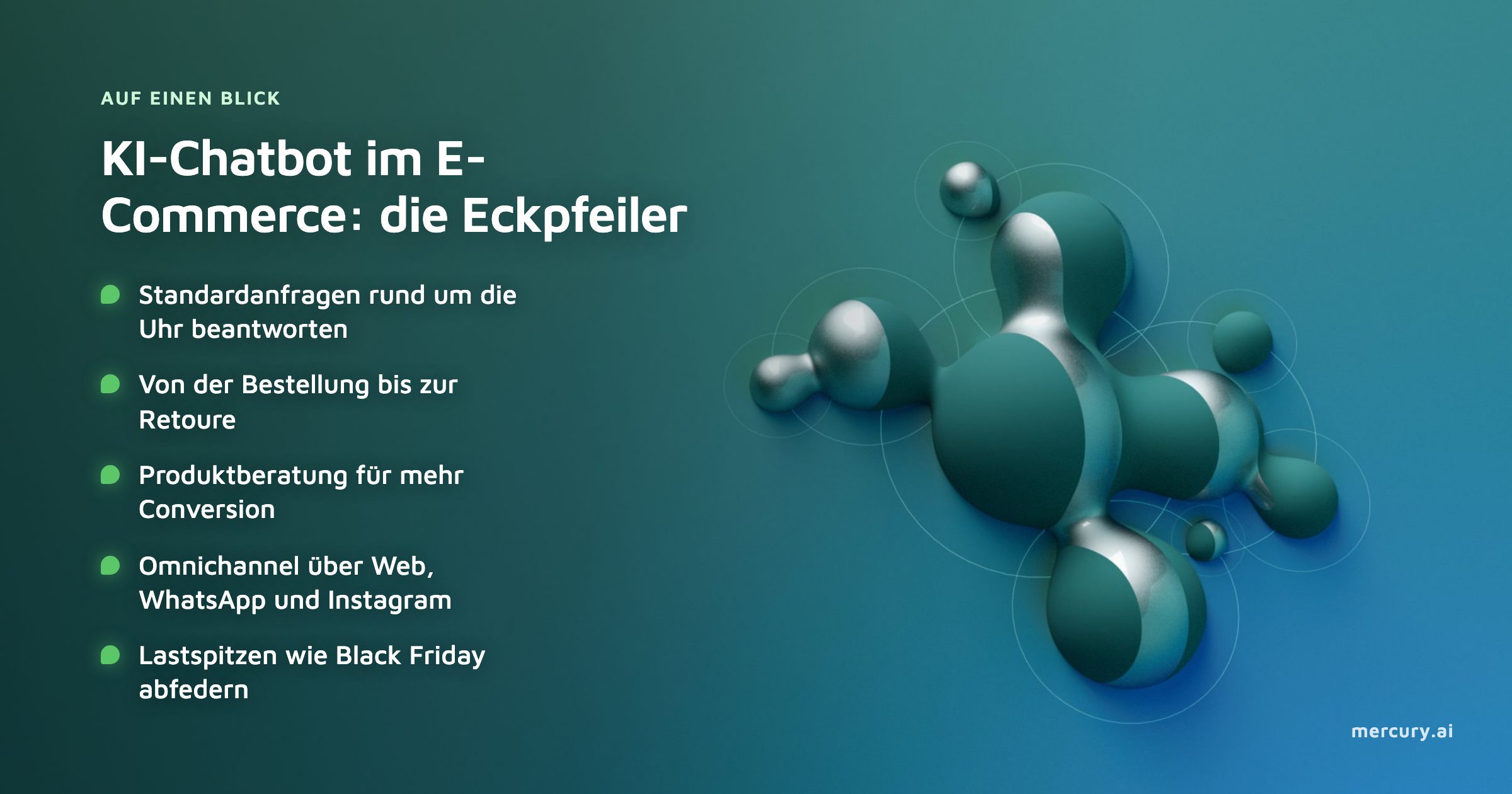
At a glance
Around the clock: Standard inquiries such as order status, shipping, and returns are automated.
Conversion: Product advice guides customers to the right item.
Omnichannel: Web chat, WhatsApp Business, and Instagram in one inbox.
Peak loads like Black Friday can be absorbed without additional staff.
Reliable answers from your verified product and order knowledge.
The two levers: Service and Conversion
In stationary retail, employees advise and answer questions. In online shops, this direct contact is missing. An AI chatbot fills this gap while contributing to two goals simultaneously. It reduces service costs by taking over repetitive inquiries. And it supports sales by guiding customers to the right product at the right moment. Both levers interlock because the same bot delivers service and advice from a single source.
Customer service: the recurring cases
A large portion of inquiries in online retail revolves around a few topics: "Where is my order?", shipping status, delivery times, availability, returns, and invoices. In many shops, such standard questions make up the majority of the volume. A chatbot reliably takes over precisely these cases, with direct integration into shop and order systems.
The added value is particularly evident outside of service hours and during peak loads. Promotions like Black Friday or the Christmas season bring a multiple of inquiries. A chatbot scales this load without additional staff and keeps response times stable. It hands over complex or disputed cases with full conversation history to an employee via the Agent Desk.
Conversion: from browsing to buying
Service is only one side of the coin. The greater impact is created when the bot actively advises. For large assortments or those requiring explanation, a digital product advisor helps translate the need into the right product, suggests suitable items, and adds them to the shopping cart. How this guided advice works is described in the article on the digital product advisor.
In this way, a product question becomes a purchase, and a looming cart abandonment is avoided. An overview of the matching building blocks can be found under Conversational AI for Marketing and Sales.
Omnichannel: Web, WhatsApp, and Instagram
Customers expect service on the channel they already use anyway. An AI chatbot serves web chat, WhatsApp Business, as well as Instagram and merges all conversations into a shared inbox. The answer remains the same on every channel because it originates from the same knowledge base.
WhatsApp in particular is popular in retail and raises data privacy issues. How the channel can be used in compliance with GDPR is explained in the article on how companies use WhatsApp without privacy concerns. The technical foundation for the channels is provided by the Chat Widget.
Reliable answers as a foundation
In e-commerce, trust depends on the accuracy of the information. Incorrect details about delivery times, availability, or return policies cost conversion and tie up service time later. A reliable chatbot therefore answers from verified sources.
The hybrid architecture separates facts from phrasing for this purpose. Answers originate from your approved product and order data, while generative AI ensures natural language. This significantly reduces the risk of hallucination and keeps the information consistent across all channels. Read more about this under Mercury Intelligence and in the Knowledge Hub. The service framework is shown by the solution for Customer Service and After-Sales.
Brands and FMCG: more than service
In the brand and FMCG environment, the chatbot becomes part of the brand experience. It answers product questions, gives application tips, and increases dwell time. Maggi and Nestlé have been using Conversational AI from Mercury.ai for years for highly personalized brand experiences.
“The AI Chatbot from Mercury.ai increases dwell time and improves the user experience.”
Grischa Marky, Senior Digital Manager, Maggi

Frequently Asked Questions (FAQ)
Which inquiries can an e-commerce chatbot take over?
Mainly recurring service inquiries such as order status, shipping, availability, and returns, plus product advice. It hands over complex cases to an employee.
Does a chatbot really increase conversion?
It helps customers make the right decision at the right moment, suggests suitable products, and answers purchase questions instantly. This reduces abandonment and supports the checkout.
Does the chatbot also work on WhatsApp?
Yes. Web chat, WhatsApp Business, and Instagram run on a single platform. For WhatsApp, GDPR-compliant setup is important.
How does the chatbot cope with Black Friday?
It automatically scales the load and keeps response times stable, even when inquiry volume increases many times over.
Conclusion
An AI chatbot is more than a service tool in e-commerce. It relieves the team of recurring inquiries and simultaneously guides customers to the right product. What matters are reliable answers from verified data and a seamless experience across all channels. Businesses that combine both improve both service and conversion at the same time.
Would you like to know how an AI chatbot can support your shop? Talk to us or take a look at the solution for Marketing and Sales.
About the author: Mirco Schmidt is CRO at Mercury.ai. He has more than ten years of experience in international and executive roles, including at the Volkswagen Group, Club Med, and the EQS Group, and holds a degree in Marketing Management from the FH des Mittelstands in Bielefeld. His focus areas are project management, marketing and sales, and communications.