


Anyone looking to introduce an AI chatbot in Germany is best advised to compare providers based on eight criteria: data location, anti-hallucination architecture, integration depth, usability, omnichannel capability, deployment time, compliance documentation, and German-language support. The market ranges from generic LLM tools and international enterprise platforms to specialized platforms from the DACH region. Each type of provider implements these criteria differently.
This guide categorizes the provider types, explains each criterion, and provides a comparison table plus an evaluation matrix to help you make a well-founded decision.
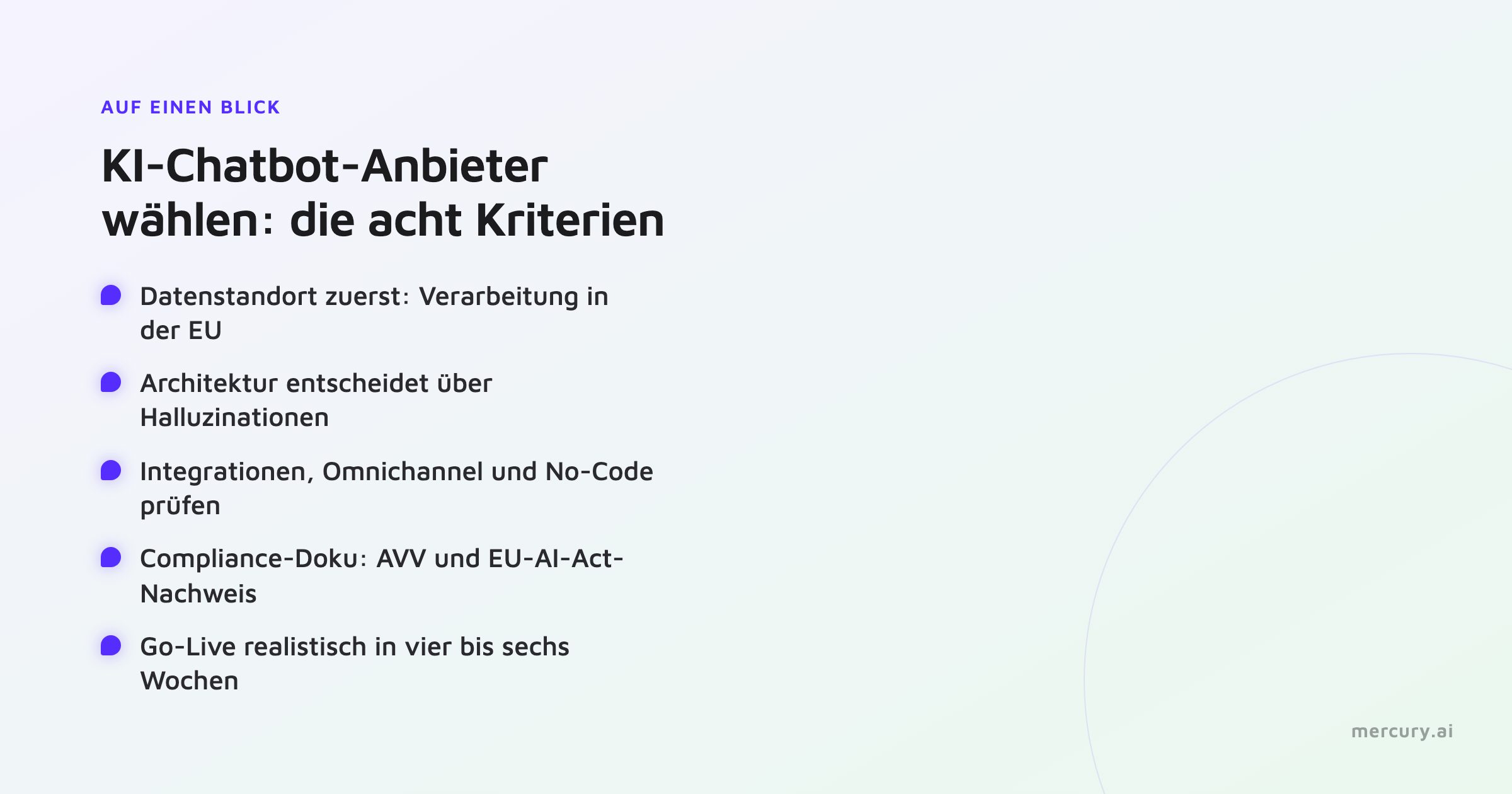
At a Glance
Eight criteria determine the choice of provider, with data location being the top priority.
EU data location: In regulated industries and the public sector, processing outside the EU is often a knock-out criterion.
Architecture beats model: Source binding protects against hallucinations, whereas a pure language model does not.
Fast is not the same as controlled: Generic LLM tools are ready to go instantly, but they relinquish control over data location and sources.
Realistic deployment time: A specialized platform with EU hosting and no-code usually achieves go-live in four to six weeks.
Tool for selection: Use the comparison table and the evaluation matrix below as a selection grid.
Why provider selection in Germany has its own standards
In Germany, two sets of regulations apply in parallel for an AI chatbot in 2026: the GDPR for personal data and the EU AI Act for the AI system itself. This shifts the selection process: functional scope alone is no longer the deciding factor; rather, it is whether a provider can prove data location, transparency, and traceability. The guide on GDPR and EU AI Act-compliant AI chatbots delves deeper into the underlying requirements.
A common misunderstanding concerns origin. "Made in Germany" describes the provider's corporate headquarters. What is decisive for data protection is where the bot processes data during operation and where it sends it. A company based in Germany can still operate its chatbot via a US cloud. What matters for data sovereignty is shown in the article on chatbot hosting in Germany.
What types of chatbot providers are there?
The market can be organized into five categories. Each has a typical profile of strengths and weaknesses.
Generic LLM and GPT tools. They are ready to start in minutes and are linguistically strong. Inputs are frequently processed outside the EU, answers are not bound to your verified sources, and shadow IT quickly emerges in service. Whether such a tool is viable in customer service is discussed in the article Is ChatGPT GDPR-compliant in customer service?.
International enterprise platforms. They offer a wide range of features for contact centers. A US corporation is often behind them, deployment takes months, and German-language support is limited.
Open-source frameworks. They give full control but require an in-house development team. Operation, maintenance, and scaling remain your responsibility.
Agencies and in-house developments. They deliver customized solutions while creating dependency. The maintenance burden is borne by the company, and scaling across multiple use cases remains open.
Specialized conversational AI platforms from the DACH region. They combine EU hosting, German-language support, and no-code operation with industry-ready building blocks. This allows them to meet German requirements directly.
The eight selection criteria in detail
1. Data location and data flows
Check two levels: where the bot is hosted and where it sends data during operation. A frontend hosted in Germany that calls a US API for every response is not data-sovereign. The robust answer is: processing exclusively in the EU, without third-country APIs.
2. Anti-hallucination architecture
A pure language model calculates the most probable phrasing without knowing the facts. A hybrid architecture separates logic from language and binds every response to verified sources. If the system finds no verified answer, it handovers to a human. How this works is explained in the article Avoiding hallucinations in AI chatbots.
3. Integration depth
A chatbot only closes service cases when it is connected to the leading systems. Ask about interfaces to CRM, ERP, ticket systems, and knowledge bases. Without integration, the bot stops at pure information delivery.
4. Usability and no-code
Clarify who will maintain the bot after go-live. A no-code platform empowers business teams to change content and dialogs without developers. This lowers running costs and shortens the time to the next adjustment.
5. Omnichannel
Customers expect the same status on website, WhatsApp, Instagram, and in internal channels like MS Teams or Slack. A provider should serve these channels from a single knowledge base so that responses remain consistent everywhere.
6. Deployment time and time-to-value
The span is wide. A specialized platform with pre-built modules often achieves go-live in four to six weeks. Open-source frameworks and in-house developments take significantly longer and tie up internal capacity.
7. Compliance documentation
A reputable provider actively delivers the evidence: data processing agreement according to Art. 28 GDPR, list of subprocessors, support for the data protection impact assessment, and a security paper on the EU AI Act. The shorter and more EU-centric the subprocessor list, the easier the proof.
8. Support, language, and roadmap
German-language support meets the reality of German service and HR teams. Additionally, ask about the product roadmap and how the provider implements new legal requirements. A chatbot is a multi-year decision.
Provider comparison: the categories at a glance
The following table contrasts the four most common provider types along the most important criteria. It compares categories; individual products may vary.
Criterion | Generic LLM tool | International platform | Open-Source / In-house | Specialized DACH platform |
|---|---|---|---|---|
Data location | mostly USA | configurable, often US corporation | self-hosted | Germany, EU |
Protection against hallucinations | low | variable | in-house effort | source-bound, hybrid architecture |
Deployment time | immediate, but uncontrolled | months | long, dev team required | four to six weeks |
No-code operation | partial | partial | no | yes |
Compliance documentation (DPA, EU AI Act) | rare | depending on provider | in-house effort | included |
German-language support | rare | limited | n/a | yes |
The table shows a pattern: Generic tools score on speed but relinquish control. Specialized platforms from the DACH region meet German requirements for data location, compliance, and support most directly.
Evaluation matrix: how to compare systematically
A table categorizes, but you decide the weighting. With this matrix, you make the comparison verifiable for your use case:
Weight the criteria. Give each of the eight criteria a weighting from 1 to 3, depending on its importance for your case. In banking, data location carries more weight; in e-commerce, omnichannel capability does.
Evaluate providers. Award 1 to 5 points per criterion for each provider on your shortlist.
Calculate. Multiply points by weighting and sum them up for each provider.
Demand evidence. Only evaluate claims that the provider can back up with a contract, documentation, or reference.
In this way, you replace gut feeling with a comprehensible ranking that you can also justify internally.
Where Mercury.ai stands in comparison
Mercury.ai is the conversational AI platform from Germany, designed specifically for the criteria in this guide:
Hosting exclusively in Germany (AWS Frankfurt,
eu-central-1). End-user data is processed exclusively there, without third-country transmission, using a single subprocessor. Customer-managed keys keep the data under your control.European, self-hosted models. There are no API calls to external providers and no training with your data. The data remains in Germany and under control.
Hybrid AI against hallucinations. The model orchestration binds responses to your verified sources, significantly reducing the risk of hallucinations, and hands over to a human if no source is available. The knowledge base is located in the Knowledge Hub.
No-code operation. Business teams maintain content and dialogs in the No-Code Studio without developers.
Omnichannel and integrations. Web, WhatsApp, Instagram, MS Teams, and Slack from a single knowledge base, connected to CRM, ERP, and ticket systems via the integrations.
Go-live in four to six weeks thanks to pre-built modules.
Compliance documentation included. The data centers used are ISO-27001 certified, and Mercury.ai aligns with ISO 27001. The approach to the EU AI Act is detailed in the EU AI Act security paper.
That this model holds up in highly regulated environments is shown by Volkswagen Bank: using Mercury.ai, they automate recurring customer inquiries 24/7, in an industry where data protection and traceability are non-negotiable.
Frequently Asked Questions (FAQ)
What should companies look for in a chatbot provider in Germany?
Eight criteria: data location, anti-hallucination architecture, integration depth, usability, omnichannel capability, deployment time, compliance documentation, and German-language support. Data location is the top priority because processing outside the EU is often a knock-out criterion in regulated industries.
Which chatbot provider is GDPR-compliant?
A GDPR-compliant provider is one that processes personal data exclusively in the EU, provides a data processing agreement according to Art. 28 GDPR, does not use your conversations to train external models, and clearly identifies the AI transparently. The full catalog of criteria is provided in the GDPR and EU AI Act guide.
What is the difference between "Made in Germany" and "hosted in Germany"?
"Made in Germany" refers to the provider's corporate headquarters. "Hosted in Germany" refers to the location where the data is processed. For data protection, the processing location and the data flows during operation are what count, not just the corporate headquarters.
How much does an AI chatbot cost in Germany?
Costs depend on scope, channels, integrations, and conversation volume. Reputable providers work with transparent pricing models instead of billing per employee. An overview of the models can be found under Pricing.
How long does it take to implement an AI chatbot?
This depends on the type of provider. A specialized no-code platform with pre-built modules often achieves go-live in four to six weeks. Open-source frameworks and in-house developments take significantly longer.
Can an AI chatbot be operated without an in-house IT department?
Yes, with a no-code platform. Business teams maintain content and dialogs themselves. In contrast, open-source frameworks and in-house developments require an internal development team for operation and maintenance.
Conclusion: measure against the checklist, not the functional scope
The choice of provider becomes verifiable when you measure each candidate against the same eight criteria and have every statement confirmed with a contract, documentation, or reference. Data location is at the forefront, closely followed by the architecture that determines hallucinations. The comparison table and evaluation matrix above provide you with the grid for a decision that will also withstand scrutiny by data protection and business departments.
Would you like to see how Mercury.ai performs against these criteria? Get in touch with us or compare our pricing models.
About the author: Mirco Schmidt is Chief Revenue Officer at Mercury.ai. He is responsible for sales and marketing and brings over ten years of experience from international leadership positions, including at Volkswagen, Club Med, and the EQS Group. His focus areas are service automation, business cases, and the introduction of conversational AI in medium-sized businesses.