


Conversational AI refers to AI systems that understand natural language and respond in dialogue, via text or speech. They combine language understanding, access to verified knowledge, and integration with business systems to resolve queries in conversation. This article answers the most frequently asked questions about Conversational AI, from its differentiation from traditional chatbots and hallucinations to data privacy, costs, and implementation.
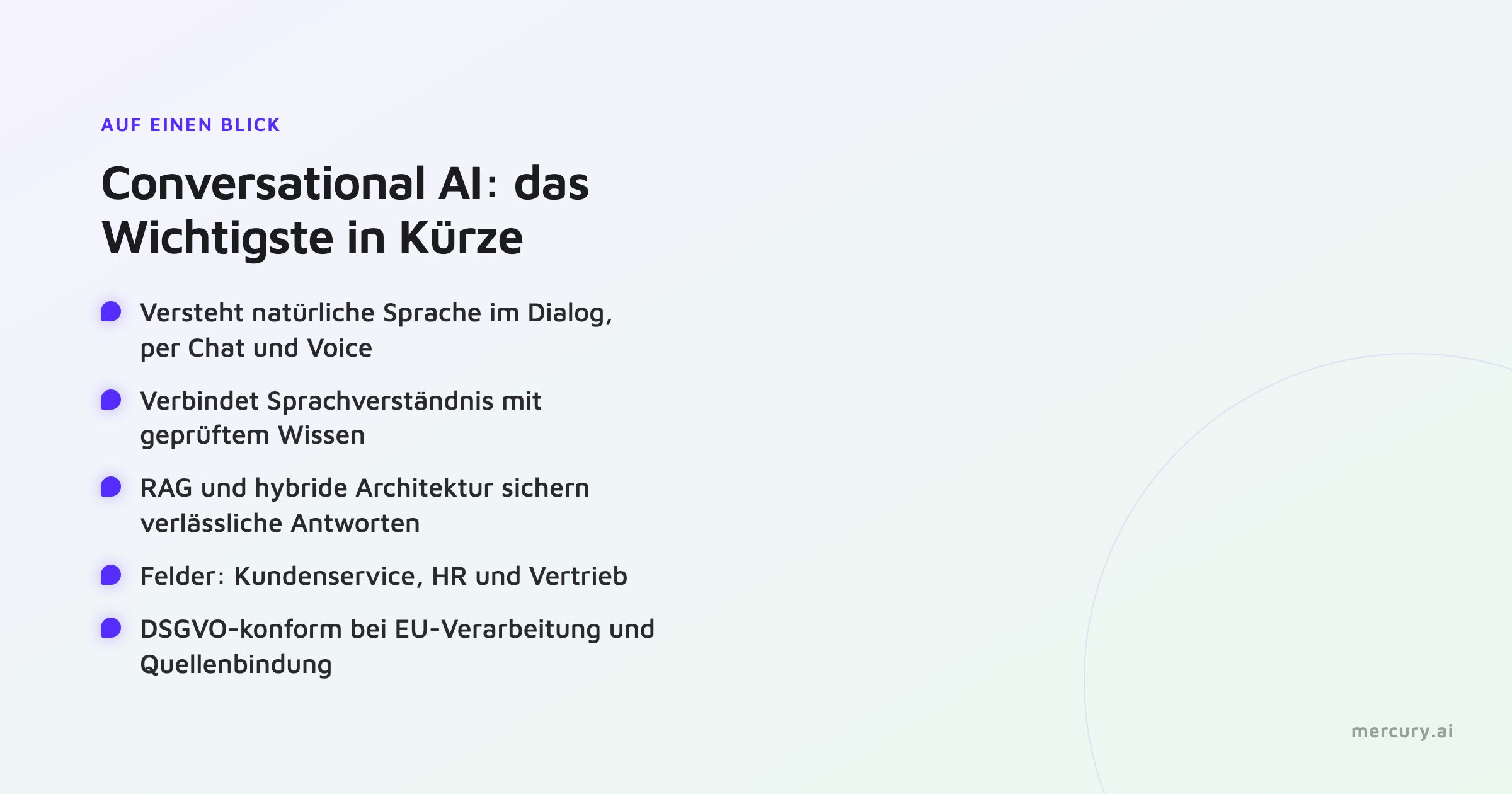
At a Glance
Dialogue instead of forms: Conversational AI understands natural language, via chat and voice.
Knowledge at the core: It combines language understanding with access to verified corporate knowledge.
Reliability through architecture: RAG and a hybrid architecture keep answers verifiable.
Typical fields: Customer service, HR, and sales.
Data privacy depends on the provider: GDPR-compliant if processing remains within the EU and answers are tied to sources.
What is Conversational AI?
Conversational AI is the technology behind systems that conduct conversations with humans. Such a system understands a freely formulated input, recognizes the intent behind it, searches for the appropriate information, and formulates a response. This happens via text in chat or via voice in a voicebot.
In enterprise applications, Conversational AI consists of several building blocks: language understanding, a knowledge base containing verified content, logic for the flow of conversation, and interfaces to the systems where the actual task is completed.
How does Conversational AI differ from a traditional chatbot?
A traditional, rule-based chatbot follows fixed decision trees. It recognizes keywords and delivers predefined answers. As soon as a question deviates from the intended path, it reaches its limits.
Conversational AI understands free phrasing, maintains context over multiple conversational steps, and accesses knowledge instead of just using templates. A customer can describe their concern in their own words, and the system categorizes it. Many platforms combine both approaches to bring controlled processes and free language together.
How does Conversational AI work technically?
A modern platform goes through several steps for each request: it recognizes the intent, finds the appropriate information in the knowledge base, verifies the source and authorization, and formulates the response from it. This setup is called a hybrid architecture because it combines rule-based control with generative language.
Access to the correct knowledge is handled by Retrieval Augmented Generation, or RAG: the system retrieves the answer from the stored sources instead of guessing it from the model's memory. At Mercury.ai, this task is performed by a model orchestra of specialized models, fed from the Knowledge Hub.
What is the difference between Conversational AI and generative AI?
Generative AI generates content such as text or images based on probabilities. Conversational AI is the dialogue system surrounding such models. It can use generative models but binds their output to verified sources and controls what reaches the user. This preserves linguistic strength while keeping the answer traceable.
Does Conversational AI hallucinate?
A pure language model can invent information because it calculates the most probable phrasing without knowing the facts. Source binding via RAG and a hybrid architecture significantly reduce this risk. If the system cannot find a verified answer, it hands over to a human. How this works in detail is explained in the article Avoiding Hallucinations in AI Chatbots.
Which channels does Conversational AI cover?
Conversational AI serves text and voice channels. For text, these include the website, WhatsApp, Instagram, as well as internal channels like MS Teams and Slack, connected via a chat widget. On the voice channel, a voicebot answers phone calls. When all channels operate from a single knowledge base, the answer remains consistent everywhere.
What do companies use Conversational AI for?
The most common areas are customer service, HR, and sales. In customer service, the system answers standard inquiries around the clock and relieves the team. In HR, it clarifies recurring employee questions. In sales, a digital product advisor guides customers from their needs to the right solution, as shown in the article on Guided Selling. Industries with high requirements, such as banking and e-commerce, also use the technology.
Is Conversational AI GDPR-compliant?
That depends on the provider. A solution is GDPR-compliant if it processes personal data within the EU, provides a data processing agreement, does not use your conversations to train external models, and transparently identifies the AI. The complete framework is provided in the GDPR and EU AI Act Guide, while provider selection is analyzed in the Selection Guide for Chatbot Providers.
How much does Conversational AI cost?
Costs depend on scope, channels, integrations, and conversation volume. Transparent providers offer pricing models based on actual usage rather than charging per employee. An overview can be found under Pricing.
How long does implementation take?
With a no-code platform and pre-built components, go-live is often within four to six weeks. In-house developments and open-source frameworks take significantly longer because operations and maintenance must be built up internally.
Conversational AI with Mercury.ai
Mercury.ai is the Conversational AI platform from Germany. The model orchestra binds every answer to your verified sources and significantly reduces the risk of hallucination. Processing runs exclusively in Germany, business teams maintain the bot without developers, and both chat and voice work from a single knowledge base. This creates a dialogue system in four to six weeks that relieves service, HR, and sales.
Conclusion: A Dialogue that Understands and Acts
Conversational AI combines language understanding with verified knowledge and integration into your systems. The difference from traditional chatbots lies in the understanding of free language; the difference from pure generative AI lies in its binding to verified sources. For productive use, architecture and data location determine whether answers remain reliable and GDPR-compliant.
Would you like to experience Conversational AI in your own company? Talk to us or take a look at the platform.
About the Author: Dr. Hendrik ter Horst is Chief Product Officer at Mercury.ai. He holds a PhD in Computer Science from the CITEC Institute at Bielefeld University, where he researched machine information extraction. For over ten years, he has been working on AI- and dialogue-based systems, from conception and implementation to production validation.